Did you know that fall protection has remained the most-cited safety violation for 15 consecutive years? In 2025 alone, nearly 6,000 violations were recorded. For a Canadian facility manager, using a professional mezzanine inspection checklist is the only way to ensure one oversight on an elevated platform doesn’t derail years of operational momentum. You’ve likely felt the pressure of balancing a growing inventory with the strict load limits of your structural steel. It’s a complex dance between maximizing every square centimetre and ensuring your team stays safe. Uncertainty about national standards shouldn’t be the thing that holds your business back from its next phase of growth.
This guide helps you master your facility’s safety, protect your people, and maximize your structural ROI. We’ll walk through everything from CSA-aligned guardrail standards to the critical torque of baseplate anchors. You’ll gain a clear roadmap for internal audits that reduce liability, improve your insurance standing, and keep your business moving forward with total confidence. By the end of this article, you’ll have the tools to transform your mezzanine from a simple storage area into a high-performance, compliant asset that supports your long-term goals.
Key Takeaways
- Learn why regular safety audits serve as a foundation for business scalability and how they protect your facility’s long-term structural ROI.
- Master the core elements of a professional mezzanine inspection checklist to identify structural risks like column deflection or anchor shifts before they become liabilities.
- Discover how to audit fall protection systems, including guardrail stability and the functionality of auto-closing pallet gates, to meet strict Canadian safety standards.
- Understand the critical difference between uniform and point loads to ensure your platform remains a high-performance asset without exceeding its engineered limits.
- Establish a strategic maintenance rhythm that balances daily visual walkthroughs with annual structural certifications to maintain a safe, compliant workplace.
Why Mezzanine Safety is a Strategic Business Priority
Safety isn’t a hurdle to your business growth; it’s the foundation of it. When you view structural integrity through the lens of performance, you see that a secure facility is a scalable facility. High-growth enterprises understand that operational momentum depends on reliable infrastructure. If your team doesn’t trust the floor beneath their feet, your throughput will inevitably suffer. Every creak or slight wobble in an elevated platform creates hesitation. That hesitation, multiplied across a workforce, slows down your entire supply chain.
Neglecting the health of your industrial mezzanines carries hidden costs that go far beyond simple repair bills. Structural fatigue, if left unchecked, leads to catastrophic downtime and surging insurance premiums. By integrating a regular mezzanine inspection checklist into your operations, you protect the structural ROI of your facility. You’re not just avoiding accidents; you’re ensuring your capital investment remains a high-value asset for decades. A well-maintained mezzanine is a “growth catalyst” that allows you to double your usable square footage without the massive overhead of a new building lease.
Protecting your workforce is your most significant responsibility and your smartest business move. Your team is your most valuable asset. When you prioritize their safety, you’re protecting the human capital that drives your revenue. Accidents don’t just cost money in Canadian Dollar (CAD) settlements; they destroy morale and damage your reputation as an employer of choice. Regular audits ensure that your growth never comes at the expense of your people.
Beyond Regulatory Compliance
Meeting the bare minimum of safety standards isn’t enough for a business with its sights on expansion. While compliance keeps the inspectors away, excellence keeps your team engaged. There’s a profound psychological impact when employees work in a space that feels robust and well-maintained. Productivity increases when people feel safe and empowered. Transitioning from reactive, “fix-it-when-it-breaks” repairs to proactive asset management using a mezzanine inspection checklist signals to your stakeholders that you prioritize stability. It moves safety from a line-item expense to a core competitive advantage.
The National Standard for Safety
The Canadian framework for elevated work platforms is designed to eliminate ambiguity and maximize reliability. Utilizing professional mezzanine systems provides a foundation of custom-engineered strength from day one. However, even the best engineering requires consistent oversight. Documented checklists are your strongest defense against liability and operational failure. They provide a transparent paper trail that proves your commitment to safety. This discipline makes it much easier to navigate audits and insurance renewals while maintaining the momentum your business needs to thrive across the country.
Structural Integrity: The Core Inspection Checklist
A mezzanine is only as strong as its connections. A thorough mezzanine inspection checklist begins with the skeleton of your structure. You need to look beyond the surface. Small shifts in base plates or minor beam deflections often signal larger issues that could compromise your facility’s expansion. By identifying these early, you protect your team and safeguard your structural ROI.
Foundation and Framing Essentials
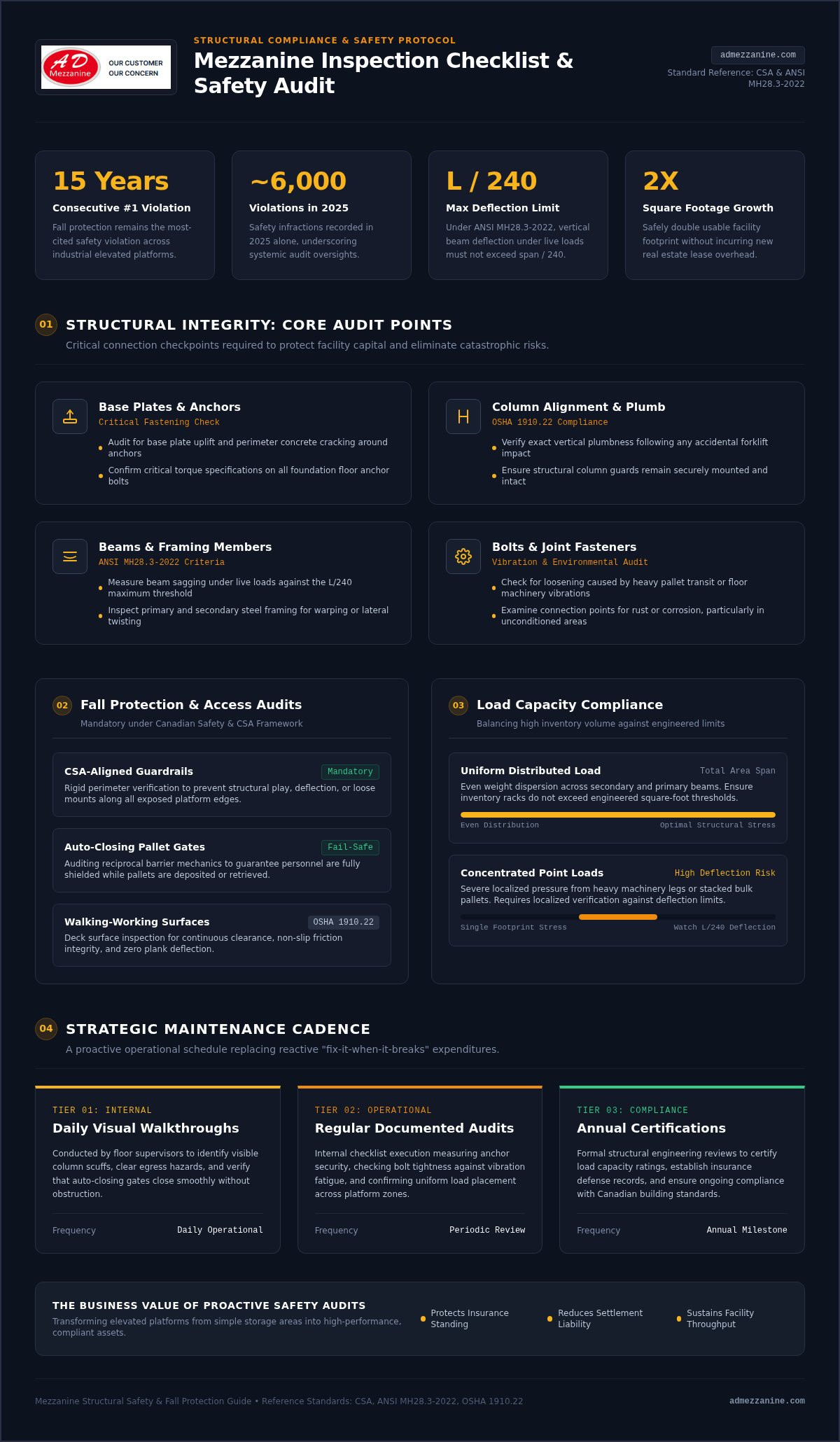
Inspect the base plates first. Look for uplift or concrete cracking around the anchors. If a forklift has clipped a column, don’t just check the paint; verify the structural “plumb” to ensure the column is still perfectly vertical. Column guards are your first line of defense, but they must be intact to be effective. Under the OSHA walking-working surfaces standard, employers are required to maintain these areas in a safe condition through regular inspections. If you notice warping or misalignment, it’s wise to speak with a structural expert about remediation.
Don’t ignore the bolts. Vibration from ground-level machinery or heavy pallet movement can loosen hardware over time. Check for rust or corrosion, particularly in unconditioned spaces. According to ANSI MH28.3-2022 standards, vertical deflection under live loads should not exceed L/240 of the span length. If you see visible sagging in your beams, you’ve likely exceeded the safety threshold and need immediate intervention.
Decking and Sub-Floor Health
Whether you use resin, bar grating, or steel decking, the floor is where your operations live. High-traffic zones often show “point load” damage first. This occurs when heavy equipment or concentrated pallet weights exceed the local capacity of the deck. Look for soft spots, dips, or warping in the floorboards. These signs suggest that sub-floor supports may have shifted or fatigued under operational stress. Keeping these components in peak condition ensures your mezzanine inspection checklist translates into a high-performance asset rather than a liability.
Safety Rails, Gates, and Access Point Audits
If the structural frame is the skeleton of your facility, then the perimeter protection is its shield. A comprehensive mezzanine inspection checklist must scrutinize every guardrail, gate, and staircase to prevent the most common industrial hazard: falls from height. According to regulatory standards, any platform 1.2 metres (4 feet) or more above a lower level requires strict fall protection. In Canada, maintaining these barriers isn’t just about avoiding significant fines; it’s about building an environment where your team moves with speed and security.
Perimeter and Fall Protection
Start with the guardrails. A standard top rail must sit between 39 and 45 inches above the deck, with a mid-rail positioned approximately halfway. Use a “tug test” to check for structural give. If a rail can’t withstand 200 pounds of force, it’s a liability, not a safety feature. Don’t overlook the kickplates. These 3.5-inch vertical barriers prevent tools or debris from sliding off the edge, protecting staff working on the ground level below.
When auditing your perimeter, look at the transition zones. Often, businesses integrate commercial bike rack systems or storage lockers near mezzanine stairs to maximize floor space. You must ensure these additions don’t obstruct egress or create trip hazards near the railing. All welds and bolt connections should align with the Storage Manufacturers Association design standards to ensure the entire system operates as a unified, high-performance safety barrier.
Access Points and Moving Parts
Pallet gates are the most active components of your mezzanine. Whether you use a pivot, sliding, or dual-reciprocating gate, mechanical fatigue is inevitable. Test the auto-closing features to ensure they snap back into place without manual intervention. A gate that sticks open is an open invitation for a workplace accident. Modern facilities are increasingly moving toward dual-barrier systems that provide continuous protection during loading and unloading.
Staircases require equal attention. Check that treads are free of debris and maintain their high-traction surfaces. If the non-slip coating has worn down, it’s time for a refresh. Handrails must be continuous and easy to grip, providing steady support for employees moving between levels. By verifying that all access points have clear, unobstructed visibility, you eliminate the “blind spot” risks that often plague busy warehouses. This methodical approach ensures your facility remains a robust catalyst for growth.
Load Capacity Management and Usage Compliance
Managing weight isn’t a static task. It’s a dynamic part of your facility’s daily operations. As your business scales, your inventory levels and equipment needs will inevitably shift. Without a rigorous mezzanine inspection checklist, these changes can lead to “usage creep,” where the weight on your platform slowly exceeds its original engineering. This hidden risk can compromise your structural ROI and create significant liability for your organization. You must treat load limits as hard boundaries that protect your team and your infrastructure.
Understanding the difference between uniform and point loads is essential for safe operation. A uniform load is distributed evenly across the floor surface, typically measured in pounds per square foot. In contrast, point loads are concentrated forces from heavy machinery or narrow-legged shelving. If your mezzanine was designed for general storage but you’ve added heavy equipment, you may be pushing the structure past its safety threshold. Identifying these concentrated loads is a critical step in maintaining a high-performance workspace.
Understanding Your Rating
Your platform’s capacity is divided into dead loads and live loads. Dead loads represent the weight of the structure itself, including the decking and framing. Live loads are the variables: your inventory, your team, and your moving equipment. High-growth businesses often find that their original live load requirements no longer match their current pace. If you’ve upgraded your pallet jacks or increased your storage density, you need to verify that your structure can handle the new stress. Updating your rating isn’t just a paperwork exercise. It’s a strategic move to ensure your facility remains a robust catalyst for expansion.
Signage and Documentation
Visibility drives compliance. Every elevated platform must have clear, permanent load plaques installed at every access point. These signs tell your team exactly what the limits are, removing the guesswork from daily loading. Legibility is key. If a plaque is faded or obscured by inventory, it’s essentially useless. Your staff needs to see these ratings every time they step onto the platform to ensure they respect the engineered limits of the space.
Beyond signage, you must maintain a complete “as-built” drawing file. These documents provide the engineered proof of your mezzanine’s capacity and are vital during annual structural certifications. Documenting every change to your layout or usage ensures you have a transparent paper trail for insurers and safety auditors. This level of organization transforms your mezzanine from a simple storage area into a disciplined, high-performance asset that supports long-term operational momentum.
Implementing a Professional Maintenance Strategy
A high-performance facility doesn’t happen by accident. It’s the result of a disciplined maintenance strategy that treats infrastructure as a living asset. While a mezzanine inspection checklist provides the framework, your team’s daily commitment provides the results. To maintain momentum, you need to bridge the gap between simple visual checks and professional structural certifications. This proactive approach ensures that minor wear doesn’t escalate into a business-halting failure.
Clutter is often the first sign of a safety system in decline. When mezzanine decks become overcrowded with temporary overflow, egress routes are compromised and load limits are tested. Integrating integrated storage solutions, such as professional storage lockers, allows you to organize inventory and personal items off the main platform. This keeps your walking surfaces clear and ensures your safety gates and guardrails remain accessible for inspection. A clean workspace is a safe workspace.
The Inspection Schedule
Success requires a three-tier rhythm. Daily walkthroughs should focus on immediate hazards like debris, blocked exits, or malfunctioning pallet gates. Monthly reviews are deeper, involving the mezzanine inspection checklist to examine bolt tightness and decking wear. However, the annual structural certification by a professional engineer is your ultimate safeguard. This deep-dive verifies the integrity of the entire system, ensuring it still meets the original design specs even after a year of heavy operational use.
Your floor staff are your most valuable eyes. Empower them to report near-misses or subtle structural changes without hesitation. If a forklift clips a column or a beam shows new deflection, you need to know immediately. Don’t wait for the next scheduled audit if you suspect a compromise. Call a professional for an immediate structural audit if you see cracked concrete around base plates or any visible warping in the steel frame.
Next Steps for Facility Leaders
Budgeting for maintenance should be viewed as a core operational investment, not a burden. The ROI of a professionally maintained mezzanine system is measured in avoided downtime, lower insurance premiums, and a longer asset lifespan. By keeping your facility in peak condition, you’re not just following the law; you’re securing your business’s future as a leader in the Canadian market. It’s about building a foundation that can support your next ten years of growth.
Secure Your Facility’s Future and Scalability
Your mezzanine is more than just extra square footage; it is a high-performance engine for your business growth. By moving from reactive maintenance to a proactive strategy, you ensure your facility remains a safe, compliant, and scalable asset. A rigorous mezzanine inspection checklist serves as your vital roadmap, covering everything from connection bolt torque to load plaque visibility. These essential steps are not just about avoiding regulatory fines—they are about protecting your most valuable asset: your workforce.
Maintaining structural integrity and unobstructed access points provides the security your team needs to operate efficiently. At A D Mezzanine Inc., we bring an engineering-led approach to mezzanine safety with professional support across design, audits, and installations. Whether you are auditing an existing platform or planning your next facility expansion, dedicated oversight makes all the difference.
Take the next step toward a safer, more resilient operation today. Your ongoing commitment to safety is the foundation for the success you will build tomorrow.
Frequently Asked Questions
How often is a mezzanine inspection required by law in Canada?
Legally, you must ensure the structural integrity of all walking-working surfaces to maintain a safe workplace. While specific provincial regulations vary, an annual structural certification by a professional engineer is the industry standard for compliance. You should complement this with a monthly mezzanine inspection checklist to catch minor issues. Consistent documentation proves your commitment to safety and helps maintain your insurance standing as your business scales.
What are the most common signs of structural failure in a mezzanine?
Look for visible deflection in beams, cracked concrete around base plates, or columns that are no longer perfectly vertical. If you notice floorboards sagging or hardware that has rusted or loosened, these are immediate red flags. Small shifts in the framing can lead to catastrophic failure if neglected. Identifying these early through a disciplined audit protects your structural ROI and keeps your facility running with organized momentum.
Can I increase the load capacity of my existing mezzanine?
Increasing load capacity is possible but requires a professional engineering assessment. You cannot simply add more weight without verifying that the columns, beams, and concrete slab can handle the additional stress. A strategic partner will evaluate your current “as-built” drawings and determine if structural reinforcements are necessary. This engineering-led approach ensures your facility’s expansion remains safe and compliant as your operational needs evolve.
What should I do if a forklift hits a mezzanine column?
Clear the area immediately and prohibit access to the platform until a structural audit is performed. Even minor impact damage can compromise the “plumb” of a column or shear the anchor bolts. Don’t just paint over the scratch; you need an expert to verify that the frame hasn’t shifted or weakened. Addressing impact damage promptly prevents localized fatigue from turning into a widespread structural failure.
Are load plaques mandatory for all elevated work platforms?
Yes, load plaques are mandatory and must be permanently displayed at every access point. These signs provide critical information about uniform and point load limits, ensuring your team respects the engineered boundaries of the space. Legible signage is a foundational element of workplace safety. Without these ratings, you risk “usage creep” where storage density exceeds the platform’s capacity, creating significant liability for your organization.
Can I perform a mezzanine safety inspection myself?
You can perform daily and monthly visual checks using a professional mezzanine inspection checklist. These internal audits are excellent for identifying debris, loose guardrails, or damaged kickplates. However, annual structural certifications must be completed by a qualified professional engineer. This combination of internal vigilance and external expertise ensures your facility remains a high-performance asset that supports long-term business growth and national compliance.
What is the difference between a safety audit and a structural certification?
A safety audit focuses on operational hazards like gate functionality, guardrail height, and egress clearance. It’s a broad look at the “walking-working” environment. In contrast, a structural certification is a technical engineering review of the frame’s load-bearing capacity and connection integrity. Both are necessary. The audit keeps your team safe daily, while the certification ensures the structure itself remains robust and dependable under stress.
How do I know if my mezzanine guardrails meet current standards?
Standard guardrails must stand 42 inches high and withstand a minimum downward or outward force of 200 pounds. Check that your mid-rails are positioned correctly and that kickplates are at least 3.5 inches tall. If your rails have significant “give” or show signs of rust at the connection points, they don’t meet the current criteria. Professional installation ensures these barriers act as a reliable shield for your workforce.