
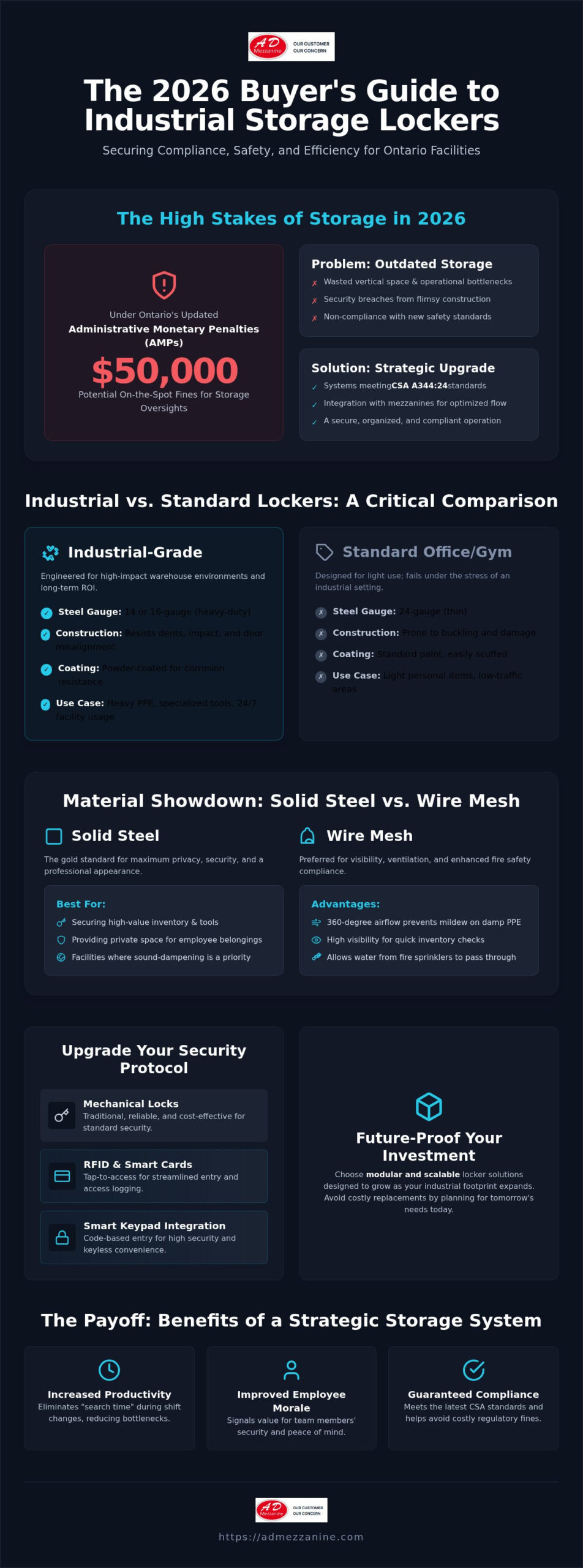
In 2026, a single storage oversight isn’t just a floor space issue; it’s a structural liability that can trigger on-the-spot fines of up to $50,000 under Ontario’s updated Administrative Monetary Penalties. Selecting the right industrial storage lockers ontario facilities require is no longer about finding the cheapest metal box. It’s about securing your inventory and your compliance in an increasingly regulated industrial landscape. You likely feel the daily pressure of wasted vertical space and the constant risk of security breaches caused by flimsy construction. It’s frustrating when your storage systems don’t integrate with your mezzanines, creating operational bottlenecks instead of streamlined flow.
We’re here to help you turn that wasted square footage into a high-performance asset. This 2026 buying guide provides the strategic clarity you need to select, price, and implement storage systems that meet the latest CSA A344:24 standards. We’ll walk through the impact of the 2025 Building Code updates, compare heavy-duty configurations, and show you how to integrate lockers into a total facility optimization strategy. You’ll move from simply managing clutter to leading a secure, organized, and fully compliant Canadian operation that’s built for momentum and long-term growth.
Key Takeaways
- Learn how to distinguish high-performance industrial storage lockers Ontario facilities require from standard office units that fail under heavy warehouse use.
- Discover the strategic trade-offs between solid steel for maximum privacy and wire mesh systems for superior ventilation and fire safety.
- Upgrade your security protocol by exploring 2026’s latest mechanical and electronic locking options, including RFID and smart keypad integration.
- Master a five-step facility audit to optimize your layout, ensuring your locker systems integrate perfectly with existing mezzanines and floor space.
- Future-proof your investment with modular and scalable locker solutions designed to grow as your industrial footprint expands.
The State of Industrial Storage Lockers in Ontario for 2026
Is your facility actually secure, or are you just using thin metal boxes? In 2026, the demand for industrial storage lockers ontario facilities can rely on has reached a new peak. The difference between a standard office locker and an industrial-grade system is a matter of structural survival. Standard units buckle under the weight of heavy PPE and industrial tools; they simply aren’t built for the high-impact environment of a Canadian warehouse. You need a solution that stands up to the daily grind of a high-density facility while protecting your most valuable assets.
Why Heavy-Duty Construction Matters
Industrial environments demand resilience. When evaluating Locker construction and materials, gauge thickness is your primary indicator of long-term ROI. Thinner 24-gauge steel might work for a school gym, but industrial settings require 16-gauge or 14-gauge steel to withstand constant impact in high-traffic loading zones. Heavy-duty construction prevents the denting and door misalignment that plague cheaper alternatives. For unconditioned storage spaces, specialized powder coatings ensure corrosion resistance, protecting your investment against the humidity and temperature swings common in large-scale Canadian facilities. It’s about buying once and buying right.
Locker Systems and Facility Efficiency
How much time does your team lose during shift changes? Disorganized storage creates a bottleneck that eats into your daily productivity. Industrial lockers are high-capacity security assets designed for 24/7 facility usage. By providing a dedicated, secure space for personal items and expensive specialized equipment, you eliminate the “search time” that delays the start of a shift. Beyond the logistics, the psychological impact is significant. Employees who feel their personal belongings and tools are secure show higher levels of engagement and retention. A secure locker area signals that you value your team’s contributions and their peace of mind.
The 2026 regulatory landscape has changed the stakes for facility managers. With the introduction of Administrative Monetary Penalties (AMPs) in Ontario, inspectors can now issue immediate fines for safety violations that previously might have resulted in a simple warning. High-performance industrial lockers contribute to a safer floor plan by removing trip hazards and securing specialized equipment. As staff numbers grow, modularity becomes a non-negotiable requirement. You need systems that scale alongside your business growth. Modern industrial storage lockers ontario facilities employ must be more than just storage; they are a proactive force for business improvement.
Comparing Construction Types: Steel vs. Wire Mesh Systems
Selecting the right material for your facility isn’t just about aesthetics; it’s a strategic decision that impacts your safety protocols and operational speed. In the high-demand world of 2026 warehousing, the choice between solid steel and wire mesh determines how well your storage integrates with your safety systems. When you invest in industrial storage lockers ontario businesses rely on, you’re choosing between two distinct performance profiles. One prioritizes total security and privacy, while the other focuses on visibility and environmental compliance.
When to Choose Solid Steel
Solid steel lockers remain the gold standard for personal belongings and high-value inventory. If your goal is to provide staff with a private space for electronics or small tools, solid construction is the answer. These units offer a clean, professional appearance and can be equipped with sound-dampening features to reduce the “locker room clang” in busy facilities. For long-term durability, choose powder-coated finishes over standard paint. Powder coating provides a resilient barrier against the daily scuffs of heavy-duty use. In environments where moisture is a factor, galvanized steel options offer an extra layer of protection against rust, ensuring your investment doesn’t degrade over time.
The Advantages of Wire Mesh in Warehouses
Wire mesh systems are the preferred choice for many high-density Ontario facilities because they solve three problems at once: ventilation, visibility, and fire safety. Unlike solid steel, mesh allows for 360-degree airflow. This is critical for drying out damp PPE or industrial gear, preventing the odors and mildew that can plague unventilated storage. From a management perspective, mesh allows for “visual auditing.” Supervisors can verify that lockers are being used correctly and that no unauthorized items are being stored, all without needing to open a single door.
Safety compliance is where wire mesh truly shines. Most modern Canadian fire codes require that storage systems don’t interfere with overhead sprinkler effectiveness. Mesh construction allows water to penetrate the locker during an emergency, whereas solid tops can create “dry zones” that allow fires to spread. Maintaining this level of transparency helps your facility stay aligned with Ontario’s Occupational Health and Safety Act regarding the safe handling and storage of materials. If you’re unsure which configuration fits your specific floor plan, it’s often helpful to speak with a facility specialist who can review your local fire requirements.
For facilities that need the best of both worlds, hybrid solutions are gaining momentum. These units use solid steel frames for structural integrity but feature perforated or mesh doors for airflow. Specialty gear lockers also cater to heavy equipment needs, offering reinforced hooks and extra-wide dimensions that standard units lack. It’s about matching the construction to the specific demands of your 24/7 operation.
Evaluating Security and Accessibility Features
Security is the backbone of facility trust. While basic lockers keep items out of sight, the high-performance industrial storage lockers ontario facilities use today integrate advanced access control to actively mitigate operational risk. Choosing the right features isn’t just about preventing theft; it’s about creating a seamless, accountable workflow that protects your equipment and your people. Drawing inspiration from the advanced entry solutions provided by AN Digital Lock, facility managers can implement similar high-tech protocols to ensure total site security. If your current systems don’t provide a clear record of access, you’re leaving your facility’s security to chance.
The traditional padlock hasp remains a versatile choice for many warehouses because it allows employees to provide their own security. However, 2026 has seen a massive shift toward keyless entry in large industrial hubs. Why the change? It comes down to accountability and maintenance. Built-in electronic locks, including RFID and smart keypad integration, eliminate the “lost key” downtime that slows down your floor. These systems provide digital audit trails, allowing you to track exactly who accessed a specific locker and when. This level of transparency aligns with the operational excellence promoted by the International Warehouse Logistics Association (IWLA). While electronic systems require more initial planning for battery or power management, the reduction in administrative burden often leads to a much higher long-term ROI.
Optimizing Tier Selection
Your choice of tier configuration should be driven by what your team actually carries. Single-tier lockers are the workhorses for full-length garments, heavy winter gear, and specialized PPE that can’t be folded. If you’re looking for a balance between capacity and density, two-tier configurations are the standard for most employee change rooms. When space is at a premium and you only need to secure small personal items like phones or wallets, 6-tier “box” lockers provide maximum density without expanding your footprint. Don’t overlook internal accessories; adding custom hooks, adjustable shelves, or dividers can turn a simple storage box into a high-utility asset. You can find more details on specific configurations by exploring our industrial lockers options designed for high-density environments.
Accessibility is a legal and ethical requirement for any modern facility. Ensuring your layout is inclusive means more than just wider aisles; it requires placing a percentage of your lockers at reachable heights and using hardware that’s easy to operate for everyone. This commitment to accessibility doesn’t just ensure compliance; it broadens your talent pool and reinforces a culture of respect. By integrating these features into your initial layout, you build a facility that’s prepared for growth and resilient against the security challenges of a 24/7 industrial cycle.
5 Steps to Optimizing Your Facility Layout
How much floor space are you losing to poorly planned storage? In 2026, real estate costs in Canada make every square foot a premium asset. Optimizing your layout for industrial storage lockers ontario isn’t just about fitting boxes along a wall; it’s about strategic spatial engineering. Follow these five steps to ensure your facility remains efficient and compliant.
Step 1 begins with a thorough audit of your staff and equipment storage needs. Don’t guess your requirements; track the volume of gear your team actually brings into the facility. Step 2 requires measuring your clear floor space and ceiling heights with precision. Most managers overlook overhead obstructions like HVAC ducts or lighting, which can interfere with locker placement or the installation of slope tops.
Measuring for Success
When planning your rows, you must account for door swing and aisle clearance to prevent operational bottlenecks. If your locker doors are 12 inches wide, your aisle needs to accommodate that swing while still allowing staff to pass by safely. A standard locker aisle requires a minimum of 36 inches of clearance for safe traffic flow. Additionally, consider the “slope top” requirement for cleanliness. Slope tops prevent the accumulation of dust and trash on top of units, making them essential for facilities that prioritize hygiene and 5S lean manufacturing standards.
Integrating with Mezzanines
Leveraging vertical space is the most effective way to expand your storage without increasing your building’s footprint. Using mezzanine storage platforms to house locker rooms allows you to keep the ground floor dedicated to production and shipping. Weight load considerations are vital for upper-level locker installations, as a full bank of steel lockers can put significant stress on a platform. Alternatively, utilizing under-mezzanine space for high-density locker banks turns often-wasted “dead zones” into high-utility security hubs. It’s a move that maximizes your existing infrastructure while keeping your team’s belongings accessible.
The final stages of optimization involve designing traffic flow to prevent congestion during shift changes and selecting protection accessories. In high-traffic zones where forklifts or heavy carts operate, you must install guard rails and bollards to shield your locker banks. Protecting your industrial storage lockers ontario investment from accidental impact ensures your facility remains organized and safe for years to come.
Scalable Locker Solutions for Modern Warehouses
Static storage is a relic of the past. If your facility is designed for today but can’t adapt for tomorrow, you’re already behind. When sourcing industrial storage lockers ontario managers must prioritize systems that offer modularity and scalability. A rigid layout is a liability in a market that demands rapid expansion and seasonal flexibility. We don’t just provide metal boxes; we offer a strategic framework that evolves alongside your business objectives.
Customization is the key to maximizing unique industrial footprints. Whether you’re dealing with awkward corners or integrating storage within existing mezzanine structures, a one-size-fits-all approach from a generic catalog won’t cut it. A D Mezzanine Inc. bridges the gap between simple shelving and comprehensive secure storage by designing layouts that respect your specific operational flow. This ensures that every inch of your facility is working toward your bottom line.
Modular Growth Strategies
Choosing locker systems that grow with your workforce is a fundamental business strategy. Standardizing your locker specs across multiple national locations ensures consistency in both security protocols and maintenance requirements. If you need to reconfigure your floor plan, relocatable locker banks allow for a flexible warehouse layout without the cost of a full teardown. This agility ensures that your infrastructure never becomes a bottleneck for your momentum. It allows you to scale your operations up or down based on real-time demand.
Total Facility Protection
A secure storage area is only as strong as its surroundings. Combining industrial storage lockers with heavy-duty safety partitions creates a dedicated high-security zone within your facility. In a high-energy environment, protecting locker banks from forklift traffic with guard rails is a non-negotiable safety measure. These accessories prevent accidental impact from compromising the structural integrity of your storage systems. By layering these protection levels, you create a robust environment that safeguards both your inventory and your personnel. Consult with our experts for a custom storage locker layout to see how these systems integrate.
While DIY installation might seem like a cost-saving measure, it often leaves your investment vulnerable to misalignments and safety failures. Professional installation ensures that every unit is level, securely anchored, and fully compliant with the structural requirements discussed earlier in this guide. This methodical approach protects your ROI and guarantees that your storage solutions perform under the pressure of 24/7 industrial use. Trusting a seasoned partner for the final implementation is the most effective way to ensure your facility remains a high-performance asset for years to come.
Future-Proof Your Facility with Strategic Storage
Success in 2026 depends on your ability to turn every square foot into a high-performance asset. We’ve covered how selecting the right industrial storage lockers ontario facilities need involves more than just picking a material; it requires a strategic approach to security, compliance, and spatial engineering. By prioritizing heavy-duty steel construction and integrating smart access features, you protect your inventory while empowering your workforce. These custom-engineered storage solutions are designed to scale with your momentum. They ensure your facility remains organized as your business expands.
Our national Canadian installation network is ready to help you implement a storage strategy that balances immediate needs with long-term ROI. Whether you’re optimizing a new warehouse or retrofitting an existing layout, the right infrastructure creates a sense of security for your team. It offers a clear competitive advantage for your brand. You’re not just buying lockers; you’re investing in a disciplined environment built for growth.
Take the next step toward a more organized and secure operation today. Your facility’s potential is waiting to be unlocked.
Frequently Asked Questions
How much do industrial storage lockers cost in 2026?
Pricing for industrial storage lockers ontario facilities varies based on construction type, tier configuration, and whether you choose pre-assembled or ready-to-assemble units. Factors like custom powder coatings for corrosion resistance or specialized sloped tops for cleanliness also influence the final investment. While prices fluctuate based on raw material costs, high-capacity welded units generally command a higher price than standard bolted systems due to their superior durability in 24/7 industrial environments.
What is the best material for warehouse lockers in unheated facilities?
Heavy-duty steel with a high-quality powder-coated finish is the most reliable choice for unheated Canadian warehouses. This finish creates a resilient barrier against the moisture and temperature fluctuations common in unconditioned spaces. For environments with extreme humidity, galvanized steel offers an extra layer of protection against rust. These materials ensure your storage systems maintain their structural integrity and professional appearance even when the facility isn’t climate-controlled during the winter months.
Are wire mesh lockers required for fire safety in Ontario?
While not always strictly mandated in every zone, wire mesh lockers are often preferred to ensure compliance with the 2025 Ontario Building Code and fire safety regulations. Mesh construction allows overhead sprinkler water to penetrate the unit during an emergency, preventing “dry zones” where fire could spread. This transparency also aids in visual safety audits, helping managers verify that no flammable materials or unauthorized items are stored incorrectly within the locker banks.
Can lockers be installed on a mezzanine level?
Yes, installing lockers on a mezzanine is an excellent way to maximize vertical space without expanding your building’s footprint. It’s critical to conduct a structural review to ensure the platform can handle the concentrated weight of steel locker banks. Under the CSA A344:24 standards, a qualified professional should verify load capacities for any new structural installation. This approach keeps the ground floor clear for production while providing secure, accessible storage for your staff.
What is the difference between 16-gauge and 24-gauge steel lockers?
The primary difference lies in the thickness and durability of the steel panels. 16-gauge steel is significantly thicker and is the standard for high-performance industrial storage lockers ontario businesses require for heavy-duty use. It resists denting and door misalignment in high-traffic zones. In contrast, 24-gauge steel is much thinner and is typically reserved for light-duty office or school environments where the risk of heavy impact or equipment damage is minimal.
Do industrial lockers come with a warranty for high-use environments?
Most reputable industrial storage providers offer warranties that cover structural defects and finish durability under normal heavy-use conditions. These warranties typically protect against door failure, weld breaks, and premature corrosion. It’s important to check the specific terms, as industrial environments put significantly more stress on hardware than commercial offices. Choosing welded construction often provides a longer service life and better long-term protection for your facility investment compared to light-duty alternatives.
How many lockers can fit in a 500-square-foot room?
In a 500-square-foot space, you can typically fit between 80 and 100 standard lockers while maintaining the required 36 inches of aisle clearance. This estimate accounts for back-to-back rows and the necessary space for door swings. Your final capacity depends on whether you use single-tier or multi-tier configurations. Utilizing vertical space through 2-tier or 6-tier units can double or even triple your storage density within the same floor footprint.
What are the benefits of electronic locker locks for large facilities?
Electronic locks, such as RFID or keypad systems, eliminate the administrative burden of managing physical keys or cutting padlocks. For large facilities, these smart systems provide digital audit trails that track exactly who accessed a locker and when. This accountability reduces internal theft and simplifies shift changes. Keyless entry also improves employee satisfaction by removing the need for staff to carry their own locks or remember complex combinations throughout their workday.