
Is your facility one forklift mishap away from a regulatory audit that could stall your operations for weeks? You likely recognize that high-traffic zones are the heartbeat of your warehouse, yet they often represent your most significant liability. Between the constant flow of heavy machinery and the pressure to hit daily quotas, the risk of equipment damage or a sudden safety violation is a constant weight on your shoulders.
This guide, brought to you by A D Mezzanine Inc., will show you how to turn that risk into a strategic advantage through professional industrial guard rail installation. You’ll learn how to secure your facility with high-impact barriers that meet current safety standards while shielding your most valuable assets from harm. We’ll explore the critical intersection of applicable building codes and occupational health and safety regulations to ensure your facility remains compliant, durable, and organized for maximum growth.
Key Takeaways
- Master the 2026 Ontario safety standards to ensure your facility remains fully compliant with OHSA regulations and Building Code requirements.
- Learn to distinguish between pedestrian and vehicle barriers to create a safe, efficient traffic flow that protects both workers and assets.
- Discover how professional industrial guard rail installation ontario provides a high-impact defense that integrates seamlessly with existing mezzanine systems.
- Identify the structural benchmarks for heavy-duty steel and precision anchoring that guarantee your safety barriers withstand industrial-grade collisions.
- Gain a strategic framework for site audits that helps you map facility danger zones and eliminate the risk of costly forklift accidents.
Compliance and Safety: Navigating Ontario Industrial Guard Rail Regulations
Safety is the silent engine of a highly productive facility. When we discuss facility safety guardrails, we aren’t just talking about yellow paint and steel beams. These are high-impact barriers engineered to separate your human capital from heavy machinery and hazardous drop-offs. In a high-velocity warehouse, industrial guard rail installation ontario serves as your first line of defense against operational chaos. By prioritizing these standards, you position your business as a reliable, established authority that values its people as much as its profits. Compliance isn’t a legal burden; it’s a strategic asset that prevents work stoppages and builds long-term trust with your employees and investors.
Understanding OHSA Standards for 2026
Ontario’s Occupational Health and Safety Act (OHSA), specifically Regulation 851 for Industrial Establishments, sets the bar for every warehouse and manufacturing plant in the province. As of 2026, the structural requirements for these rails are tied directly to the Ontario Building Code. The top rail must sit between 91 and 107 centimetres above the surface it guards. You’ll also need a mid-rail to prevent falls and a toeboard at least 125 millimetres high if there’s a risk of tools falling on workers below. Industrial guard rails in Ontario must be capable of withstanding a force of at least 200 pounds (890 N) applied in any downward or outward direction at any point along the top rail. These benchmarks ensure that your infrastructure isn’t just ornamental but functionally capable of stopping a disaster before it starts.
The Consequences of Non-Compliance
Cutting corners on safety infrastructure leads to more than just a slap on the wrist from an inspector. Ministry of Labour fines can be staggering, but the indirect costs of workplace accidents are often much higher. In 2018, falls were the third-highest cause of lost-time injury claims with the WSIB in Ontario, proving how quickly a lack of protection can derail your business momentum. Professional industrial guard rail installation ontario creates a verifiable paper trail for safety audits and corporate transparency. This organized approach doesn’t just satisfy government inspectors; it can actively reduce your insurance premiums by proving your commitment to a certified safety environment. Investing in the right hardware today secures your business against the legal and financial liabilities that can surface tomorrow.
Types of Industrial Guard Rails for Warehouses and Manufacturing
Selecting the correct barrier system isn’t a one-size-fits-all decision. It’s a strategic choice based on your facility’s unique traffic profile. Are you guiding pedestrians through a safe walkway, or are you shielding a multi-level mezzanine from a 10,000-pound forklift? Understanding the distinction between pedestrian and vehicle barriers is the first step toward an effective industrial guard rail installation ontario project. High-visibility finishes, typically in safety yellow, provide a critical visual deterrent that signals danger zones to operators before a collision even occurs.
While permanent floor-mounted rails offer the highest level of structural security, some facilities benefit from removable systems in areas where equipment access needs change frequently. This flexibility allows you to maintain a high safety standard without sacrificing operational agility. Following the guidelines in Ontario Regulation 851 ensures that whichever system you choose, it meets the rigorous legal requirements for industrial establishments in the province.
Heavy-Duty Steel Guard Rails
Heavy-duty powder-coated steel remains the commercial benchmark for 2026. These systems are designed to absorb and deflect massive amounts of kinetic energy, making them the industry standard for forklift protection. If you’re managing high-traffic zones, a double or triple rail configuration provides the necessary height and strength to stop heavy machinery from breaching safety perimeters. These rails don’t just protect; they provide an emotional sense of security for your team, knowing that their workspace is fortified by structural-grade steel.
Polymer and Flexible Barrier Systems
In certain environments, rigid steel might not be the most cost-effective long-term solution. Polymer-based flexible barriers are gaining popularity because they can absorb an impact and return to their original shape. This flexibility prevents the kinetic energy of a collision from being transferred directly into the concrete floor, which often leads to expensive floor repairs. These systems are also naturally resistant to corrosion, making them ideal for high-moisture zones or facilities that require frequent wash-downs. If you’re unsure which material best suits your layout, consulting with a safety expert can help you map out a hybrid strategy that maximizes both protection and budget.
Structural Integrity: Material Standards and Impact Ratings
Structural integrity isn’t just a technical specification; it’s the insurance policy for your facility’s physical assets. In 2026, heavy-duty powder-coated steel remains the gold standard for interior protection. While some competitors focus on outdoor galvanized finishes, indoor environments require high-visibility finishes that resist the specific scuffs and impacts of warehouse life. When planning an industrial guard rail installation ontario project, you must evaluate the welding quality and the structural gauge of the hardware. A thin-walled rail might look the part, but it won’t provide the assertive defense your expensive machinery requires during a real-world collision.
Durability in Ontario also means accounting for our unique climate. Even in unheated warehouses, temperature fluctuations can cause concrete floors to expand and contract. High-quality steel barriers are engineered to handle these shifts without compromising their anchoring. By choosing robust materials, you aren’t just meeting a code; you’re building a foundation for business momentum that won’t be derailed by equipment failure or structural collapse.
Impact Ratings and Deflection Zones
Calculating the necessary impact rating is a strategic necessity. You need to account for the maximum weight of your heaviest forklift multiplied by its top speed in high-traffic zones. This data allows you to determine the deflection zone, which is the amount of space the rail might move upon impact. Protecting your most expensive equipment from downtime is the ultimate goal of the “Growth Catalyst” approach. Structural steel remains the preferred choice for high-load zones because its rigid composition provides the highest level of kinetic energy absorption during vehicle impacts. Integrating these barriers with industrial mezzanine systems ensures that even multi-level storage areas remain shielded from ground-level accidents.
Anchor Systems and Mounting Hardware
The strength of a guard rail is only as reliable as its connection to the floor. Professional installations typically utilize either mechanical wedge anchors or chemical epoxy anchors. Mechanical anchors are excellent for standard cured concrete, while chemical anchors provide superior hold in aged slabs or high-vibration zones where machinery runs constantly. Base plate thickness is equally critical; a wider, thicker plate distributes the force of an impact across a larger surface area, preventing the concrete from spalling. Establishing a maintenance schedule to check anchor integrity is a disciplined way to ensure your safety infrastructure remains as dependable in year five as it was on day one.

Strategic Space Planning: Integrating Rails into Commercial Layouts
Effective space management transforms a chaotic warehouse floor into a high-performance environment where every square foot serves a purpose. Industrial guard rail installation ontario is not just a safety checkbox; it is a strategic tool for defining your facility’s operational boundaries. By conducting a thorough site audit, you can map out “danger zones” where forklifts and pedestrians intersect. This proactive approach allows you to optimize aisle widths while maintaining a secure perimeter around your most vital assets. It aligns perfectly with the philosophy of maximizing your space without compromising the security of your team.
When you install industrial mezzanine systems, the safety requirements shift from ground-level impact protection to vertical fall prevention. A well-planned layout ensures that your multi-level storage doesn’t create new risks for workers on the ground. Similarly, creating a seamless storage hub often involves grouping integrated storage lockers within protected zones. This organization ensures that staff can access personal items or equipment without entering high-traffic forklift lanes, maintaining a smooth and predictable traffic flow across the entire facility.
5 Steps to a Safer Facility Layout
Building a safer layout requires a methodical approach that balances protection with productivity. First, you must identify forklift turn radii to ensure rails do not become collision magnets in tight corners. Second, map out pedestrian crossing points to create clear, guarded walkways that are easily visible to equipment operators. Third, use zoning to define specific work cells and storage areas, separating high-load zones from low-traffic administrative spaces. Fourth, verify that rail placement does not obstruct emergency exits or fire safety equipment. Finally, align your rail height with the specific visibility needs of your operators to prevent blind spots in critical intersections.
Mezzanine and High-Level Protection
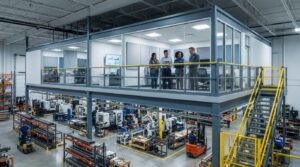
Elevated work platforms require a specialized approach to guard rail design that accounts for both impact and gravity. Fall protection standards for these platforms are non-negotiable under Ontario law, requiring top rails to be positioned between 91 and 107 centimetres above the floor. Integrating kickplates is essential to prevent tools or debris from falling to lower levels, where they could cause injury or damage expensive machinery. By combining handrails and heavy-duty guard rails, you create a comprehensive security envelope for your mezzanine. This disciplined setup protects the workers above while shielding the assets stored below from ground-level accidents.
Professional Installation: Ensuring Long-Term Facility Protection
Choosing between off-the-shelf hardware and professional industrial guard rail installation is a decision that impacts your facility’s long-term resilience. While DIY solutions might seem cost-effective initially, they often lack the structural certifications required to withstand industrial-grade impacts. A professional approach ensures that every barrier is anchored with precision, creating a shield that doesn’t just look secure but performs under pressure. It’s about building a foundation of reliability that allows your business to scale without the fear of structural failure.
Long-term stability depends on the depth and quality of concrete anchoring. Professional installers use high-torque fasteners and specialized drills to ensure rails remain rigid even in high-vibration zones. Precision matters. This methodical, disciplined approach to industrial guard rail installation ontario also prioritizes your operational momentum. By staging the installation in phases, experts minimize downtime, allowing your facility to expand its safety footprint without stalling daily production. You gain a partner in A D Mezzanine Inc. who is as invested in your uptime as you are.
Reducing Liability Through Certified Installation
Why does professional certification matter for your safety equipment? It provides a critical paper trail for safety audits and insurance providers, proving that your infrastructure meets provincial standards. Professional installers guarantee the load-bearing capacity of wall and floor mounts, ensuring they meet the structural requirements set out in the Ontario Building Code. This reliability prevents the common issue of rail loosening, which is a frequent failure point in high-traffic environments where equipment constantly brushes against barriers. Secure anchoring is your best defense against the legal and financial fallout of a workplace accident.
Custom Solutions for Industrial Spaces
Every warehouse has its own quirks, from uneven floor slabs to non-standard pillar placements. Adapting safety hardware for these unique configurations requires a partner who sees the big picture. This might involve integrating commercial amenities into your exterior safety plan or creating custom partitions for sensitive equipment zones. A D Mezzanine Inc. operates as a growth catalyst, providing the transparency and organization needed to secure your facility for the long haul. We focus on the “why” of your business growth, ensuring your safety systems support your expansion rather than hindering it.
Fortify Your Operations and Accelerate Your Growth
Securing your facility is more than just a regulatory hurdle; it’s a strategic investment in your business momentum. By aligning your warehouse with 2026 Ontario safety standards and utilizing high-impact structural steel, you protect your most valuable assets from the daily risks of industrial traffic. Professional industrial guard rail installation ontario provides the reliable, certified defense your facility needs to pass audits and prevent costly operational downtime. You’ve seen how strategic planning and precision anchoring turn a simple barrier into a long-term safety asset.
Expertise in structural steel and OHSA compliance ensures your high-traffic zones remain functional and secure. As your strategic partner for warehouse space optimization, we help you navigate the fine details of load-bearing capacities and traffic flow mapping. It’s time to transform your facility into a disciplined, high-performance environment that values security as much as speed.
Take the next step toward a safer, more efficient workspace today. Your business deserves a foundation built on strength and professional reliability.
Frequently Asked Questions
What is the required height for industrial guard rails in Ontario?
In Ontario, the top rail must be positioned between 91 and 107 centimetres above the surface it guards. This standard is dictated by OHSA Regulation 851 and the Ontario Building Code to ensure consistent fall protection across all industrial establishments. You also need a mid-rail and a toeboard if there’s a risk of tools or debris falling on workers below, creating a comprehensive safety envelope for your team.
Can industrial guard rails be installed on existing concrete floors?
You can absolutely install these systems on existing concrete floors using specialized anchoring hardware. Professional industrial guard rail installation ontario utilizes mechanical wedge anchors or chemical epoxy systems to create a permanent, high-strength bond with the slab. We evaluate the concrete thickness and condition during a site audit to ensure the mounting hardware provides the necessary load-bearing capacity for your specific equipment and traffic patterns.
What is the difference between a guard rail and a handrail in a warehouse?
A guard rail is a structural barrier designed to prevent falls from heights or protect assets from vehicle impacts. In contrast, a handrail is specifically intended to provide hand support for people climbing stairs or ramps. While both are essential for facility safety, guard rails must meet much higher structural load requirements to stop heavy machinery or prevent a person from falling through a floor opening.
How much impact can a standard steel industrial guard rail withstand?
While there’s no single government-mandated impact rating, many high-quality steel rails are tested to withstand a 10,000-pound load at four miles per hour. The actual resistance depends on the steel gauge, post spacing, and anchor depth. Choosing structural steel ensures your barriers absorb kinetic energy effectively, protecting your expensive machinery from the devastating downtime that follows a forklift collision in your high-traffic zones.
Are yellow safety rails required by Ontario law for all warehouses?
While Ontario law doesn’t explicitly name yellow as the only legal color, it mandates that hazards be clearly identified with high-visibility markings. Safety yellow has become the commercial benchmark because it provides the highest contrast in warehouse environments. Using this standard color ensures your safety infrastructure is immediately recognizable to operators, helping you maintain a compliant facility that meets the spirit of provincial safety regulations.
Do I need a building permit for industrial guard rail installation?
You typically need a building permit if the installation is part of a larger structural project, such as a new mezzanine or a major facility reconfiguration. Since guard rails are governed by the Ontario Building Code, it’s important to verify requirements with your local municipality. Professional installers help you navigate this process, ensuring your safety upgrades are fully documented and compliant with all provincial and local regulations.
How often should industrial guard rails be inspected for safety compliance?
You should inspect your safety barriers at least once a month as part of your internal safety audits. Any rail that has sustained a vehicle impact must be inspected immediately and replaced if the structural integrity is compromised. Regular checks for loose anchors or surface corrosion ensure your industrial guard rail installation ontario remains a reliable asset that continues to protect your people and your property for years.
Can guard rails be integrated directly into a mezzanine structure?
Guard rails are a fundamental component of any industrial mezzanine structure and must be integrated into the perimeter to provide fall protection. This integration often includes kickplates to prevent tools from falling and specialized gate systems for pallet loading. A unified design ensures that your mezzanine remains a safe, productive extension of your warehouse floor without creating new hazards for workers operating on the levels below.