Is your safety budget actually protecting your floor, or is it just leaking capital through overlooked shipping fees and installation gaps? You understand that securing a high-traffic facility is a non-negotiable priority for maintaining operational momentum. However, between shifting freight trends and complex impact ratings, pinning down a reliable industrial guard rail cost Canada estimate often feels like hitting a moving target.
It’s time to stop guessing and start strategizing. This guide empowers you to master the pricing variables of 2026, ensuring every dollar spent reinforces your facility’s long-term value and protects other critical investments like mezzanines or storage units. We’ll explore the ROI of traditional steel versus modern polymer options, break down the latest CSA compliance standards, and provide a clear framework for budgeting everything from modular hardware to national shipping logistics. You’ll gain the professional clarity needed to turn a mandatory safety requirement into a high-performance business asset that drives growth and secures your team’s future.
Key Takeaways
- Learn how strategic guard rail placement transforms safety compliance into a performance driver by allowing faster, more confident facility movement.
- Discover the core variables that dictate industrial guard rail cost canada in 2026, including material market trends and specific impact rating requirements.
- Compare the long-term ROI of carbon steel versus high-density polymers to determine which material best protects your specific equipment and floor plan.
- Identify hidden project expenses by accounting for national freight variables and professional installation labor across different Canadian provinces.
- Move beyond “one size fits all” solutions by aligning your safety infrastructure with long-term business growth and facility optimization goals.
The Strategic Value of Safety: Why Budget for Guard Rails in 2026?
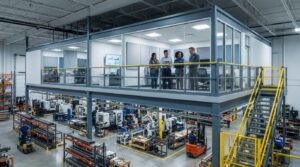
Safety in a Canadian facility isn’t just a regulatory box to check; it’s a performance-driven investment. When you evaluate the industrial guard rail cost canada, you aren’t just buying steel or polymer. You’re buying the ability to push your facility’s throughput to its absolute limit without the constant shadow of liability. In 2026, high-performance warehouses treat a Guard rail as a strategic asset that shields other major investments, such as industrial mezzanine structures, from the inevitable wear of high-traffic operations. It’s about protecting your momentum as much as your people.
Operational Momentum and Risk Mitigation
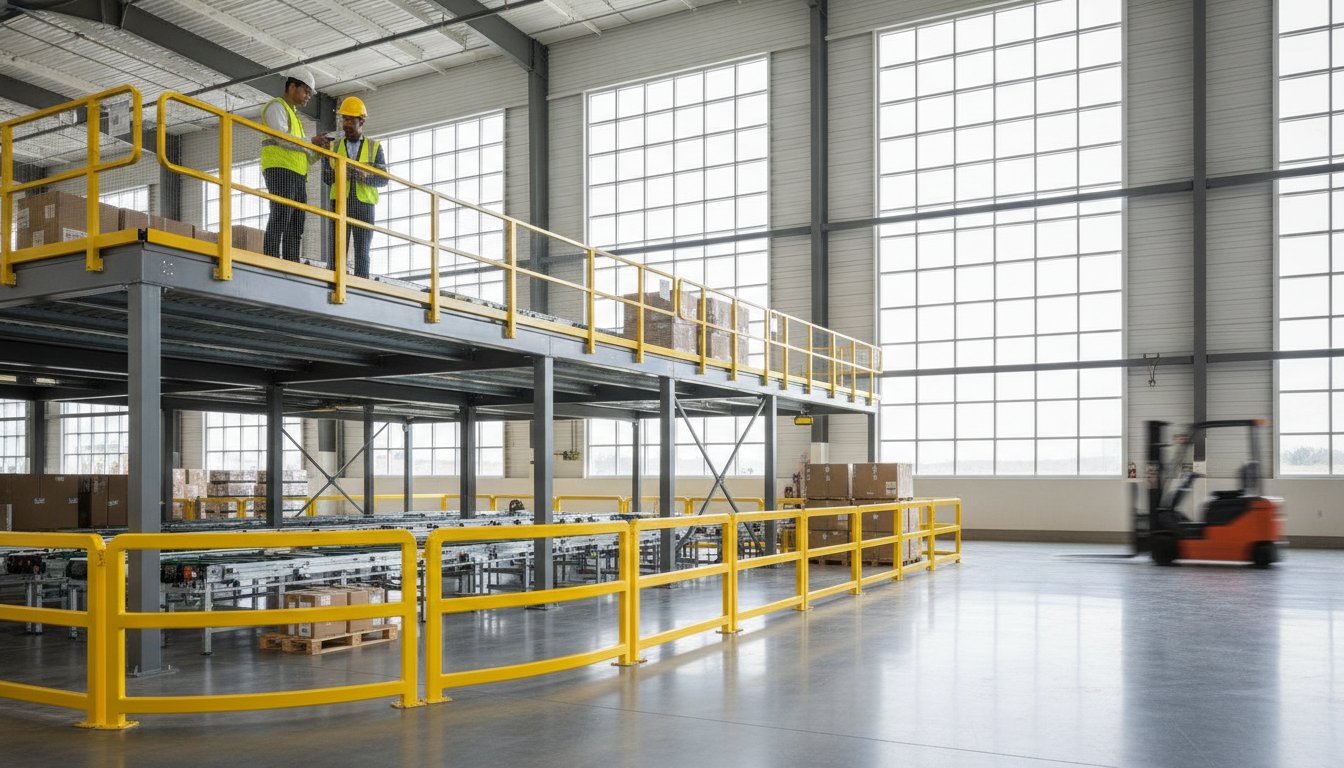
Think about your forklift operators. Without physical barriers, they navigate with hesitation. They slow down near columns or expensive equipment to avoid collisions. Secure perimeters act as an operational accelerator. They provide a clear visual and physical boundary that allows for faster movement and higher precision. This reduces operator anxiety and fatigue, which are silent killers of productivity and workforce retention. Beyond speed, consider the cost of downtime. A single collision with a structural support can halt production for days. By installing modular barriers, you ensure that an impact results in a replaceable rail segment rather than a catastrophic structural failure that drains your capital.
Meeting 2026 Canadian Safety Standards
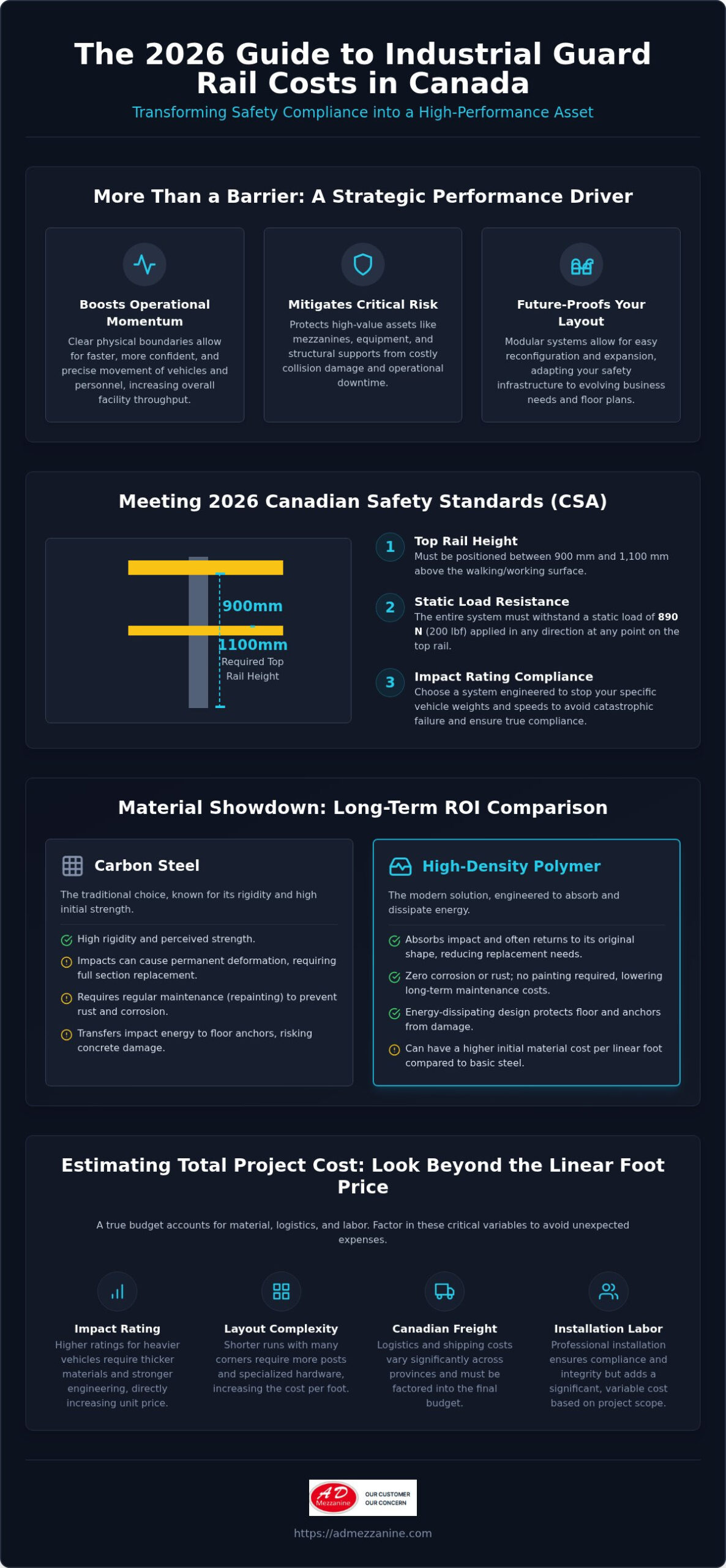
Compliance isn’t getting any cheaper. Canadian safety regulations, updated as recently as July 2026, demand rigorous standards for physical barriers. For instance, the top rail must sit between 900 mm and 1,100 mm above the base, and the system must withstand a static load of 890 N applied in any direction. Ignoring these CSA and provincial requirements leads to more than just fines; it triggers massive spikes in insurance premiums. Modern Canadian facilities are shifting toward “impact-tested” solutions that exceed these minimums. These systems integrate into smart facility management, where the physical barrier is the first line of defense in a broader, data-driven safety ecosystem. When calculating your total industrial guard rail cost canada, factor in the long-term savings of avoiding these penalties. By budgeting for modularity now, you future-proof your floor plan, allowing for easy reconfigurations as your business expands.
Primary Cost Drivers: Materials, Ratings, and Modular Design
Why does a 10-foot section from one supplier cost double that of another? When calculating your industrial guard rail cost canada, the answer usually lies beneath the surface of the paint. In 2026, the Canadian steel market has stabilized after the volatility of previous years, but secondary costs like galvanizing and specialized freight continue to climb. Choosing between traditional carbon steel and high-density polymers isn’t just about the initial invoice; it’s about matching the material’s physical properties to your facility’s traffic volume and environmental conditions.
Understanding Impact Resistance and Engineering
Impact Rating is the measure of a rail system’s ability to stop a specific vehicle weight at a specific speed. If your fleet consists of heavy-duty 30,000 lb forklifts, a standard 10,000 lb rated rail is essentially a cosmetic suggestion. Engineering a post to absorb and dissipate kinetic energy requires specialized internal dampening or thicker gauge steel, which naturally drives up the unit price. To remain compliant with the Canada Occupational Health and Safety Regulations, you must ensure your chosen rating can withstand the static and dynamic loads unique to your operation. Investing in higher ratings now prevents the catastrophic costs of structural failure later.
Component Breakdown: Posts, Rails, and Hardware
Linear foot pricing is a helpful benchmark, but it’s often misleading for complex layouts. Shorter, segmented runs require more posts and specialized hardware like corner connectors and heavy-duty base plates, increasing the total cost per foot. Consider these factors when mapping your floor:
- Configuration: A double-rail setup effectively doubles your material investment but is necessary for high-danger zones where vehicle breach is a risk.
- Hardware: The quality of floor anchors and base plates dictates the system’s integrity. High-performance hardware adds to the upfront cost but reduces long-term maintenance.
- Modularity: While custom fabrication offers a tailored fit, the “modular premium” of off-the-shelf components usually pays for itself through significantly lower installation labor and easier future repairs.
In the humid or salt-exposed environments common in many Canadian regions, the finish matters just as much as the metal. Powder coating provides high visibility and a professional look, while galvanized steel offers superior corrosion resistance for unheated spaces or loading docks. If you’re unsure which configuration fits your 2026 budget, consulting with a specialist can help you avoid over-specifying or under-protecting your floor.
Steel vs. Polymer: Comparing Price Points and Long-Term ROI
Choosing the right material for your facility isn’t a simple binary choice between plastic and metal. It’s a calculation of Total Cost of Ownership (TCO). While the initial industrial guard rail cost canada for carbon steel is often lower than high-performance polymers, the long-term financial trajectory of each material tells a different story. You must decide if you want to pay more at the loading dock today or more in maintenance labor over the next five years. This decision directly impacts how well you protect secondary investments, such as secure storage lockers and sensitive electrical panels, which are often positioned right behind these barriers.
The Case for Heavy-Duty Steel
Steel remains the gold standard for pure stopping power. If your primary goal is protecting structural columns or mezzanine supports from high-capacity machinery, steel provides a rigid, unyielding defense. It’s built for environments where “near misses” aren’t just common; they’re expected. Beyond its physical strength, steel offers a unique financial benefit: secondary market value. If you ever decommission or reconfigure your facility, steel components retain a resale or scrap value that polymers simply cannot match. However, you must budget for the maintenance cycle. Steel is prone to rust and requires occasional repainting to maintain the high-visibility yellow required for safety compliance. When a forklift makes contact, the rail usually dents, requiring a full section replacement to restore its structural integrity.
The Case for Flexible Polymer Systems
High-density polymers represent the modern, performance-driven approach to facility safety. The “secret sauce” of polymer is its ability to rebound. Instead of denting or bending upon impact, these systems flex to absorb kinetic energy and then return to their original shape. This dramatically reduces collision recovery costs because you aren’t replacing rails after every minor scrape. Perhaps the biggest ROI factor for polymer is floor protection. Because the base is designed to flex, it transfers significantly less stress to your concrete floor. This prevents the “pothole” effect where anchor bolts are ripped out of the slab, saving you thousands in specialized concrete repairs. Polymer is also color-molded, meaning it never needs painting and won’t peel in high-moisture or chemical-heavy zones. Its lighter weight also makes it a favorite for small-team setups, reducing the labor hours required for a full-scale rollout.
The ultimate decision depends on your traffic patterns. For perimeter protection where impacts are rare but potentially catastrophic, steel’s lower upfront price is attractive. For high-traffic aisles where daily scrapes are part of the job, polymer’s zero-maintenance profile and floor-saving technology often deliver a superior ROI within the first 24 months of operation.
Estimating Total Project Costs: Installation and Canadian Logistics
The quote on your desk is only the first step in a complex financial equation. To truly master your industrial guard rail cost canada, you’ve got to look beyond the fabrication shop and account for the logistical reality of the Canadian landscape. Moving heavy-duty steel or high-density polymers from a central hub to a remote job site can quickly erode your budget if you haven’t accounted for the landed cost. In 2026, where fuel surcharges and specialized freight rates fluctuate, strategic logistics planning is as important as the material selection itself.
Logistics and Freight in the Canadian Market
Shipping costs typically add an extra 10% to 20% to your material total. Because industrial safety equipment is heavy and often oddly shaped, freight companies charge based on a weight-to-shipping ratio that punishes small, segmented orders. You can mitigate these surcharges by consolidating your safety infrastructure purchases. If you’re already planning for commercial bike storage or pedestrian walkways, ordering the components together reduces the per-unit freight impact. This organized momentum ensures your capital is spent on protection, not just diesel. It’s a strategic move that turns a logistical hurdle into a cost-saving opportunity.
Professional Installation vs. DIY
Installation labor often equals the material cost of the project. While DIY assembly seems like a cost-saving measure, it requires a significant investment in specialized tools. You’ll need industrial hammer drills, precision torque wrenches, and floor leveling equipment to ensure the base plates sit flush against the concrete. Professional installation typically ensures compliance with manufacturer warranty terms. Beyond the tools, consider the liability. Professional installers carry the insurance and certification required to sign off on a system’s integrity, protecting you from future insurance disputes. Site preparation also plays a role; if your floor isn’t level, the time spent shimming and anchoring will drive up labor hours. When these factors are ignored, your total industrial guard rail cost canada can spiral beyond your initial projections.
Scaling for growth requires a disciplined approach to facility design. By accounting for floor leveling and anchoring requirements now, you create a foundation for future expansion. Whether you’re adding more mezzanines or reconfiguring your loading zones, a well-documented installation process makes every subsequent phase smoother and more predictable. Don’t let hidden costs stall your progress; budget for the full lifecycle of the project from the start.
Securing Your Facility with AdMezzanine Guard Rail Solutions
Safety shouldn’t be an afterthought in your 2026 expansion plans. When you evaluate the industrial guard rail cost canada, you’re looking for more than just a price per linear foot. You’re looking for a partner who understands the high stakes of industrial momentum. AdMezzanine provides that authoritative expertise. We don’t just ship hardware; we deliver custom-engineered solutions that turn your warehouse into a fortified, high-performance environment. By aligning your safety infrastructure with your broader business growth goals, we ensure that every barrier serves a purpose beyond basic compliance.
Our systems are designed to integrate seamlessly with our other core infrastructure offerings. Whether you’re installing heavy-duty industrial mezzanines or setting up secure storage lockers, our guard rails act as the essential first line of defense. This unified approach eliminates the friction of managing multiple vendors. It ensures your facility layout is optimized for both safety and speed. We serve the entire Canadian market, bringing national reliability and a disciplined project management style to every site we touch.
The AdMezzanine Strategic Advantage
We take a methodical approach to facility safety. We don’t believe in “one size fits all” because your floor plan and traffic patterns are unique. Our team acts as a growth catalyst, helping you identify high-risk zones before they become costly downtime events. We prioritize transparency in our communication, providing national clients with clear timelines and organized service breakdowns. You’ll work with a seasoned expert who is deeply invested in your success, ensuring your safety investment supports long-term operational efficiency rather than just being a static expense on a balance sheet.
Next Steps for Your 2026 Budget
Navigating the variables of impact ratings, material choices, and Canadian logistics is easier with a mentor in your corner. Pinning down a realistic industrial guard rail cost canada requires a site-specific analysis that accounts for your forklift fleet and load weights. The process begins with a performance-driven consultation where we map out your needs and align them with your budget. From the initial quote to the final professional installation, we move with a sense of organized momentum to keep your project on track.
Ready to harden your facility against risk while accelerating your throughput? Take the next step in your facility optimization journey today.
Optimize your facility safety with AdMezzanine
Future-Proofing Your Facility Momentum
Mastering your industrial guard rail cost canada is about more than just checking a compliance box. It’s a strategic move to protect your operational flow and your high-value infrastructure. We’ve explored how material selection and impact ratings dictate long-term ROI. We also analyzed why accounting for national logistics is essential for a realistic 2026 budget. These variables define whether your safety spend is a drain or a driver of efficiency.
AdMezzanine stands ready as your strategic partner. We offer expert industrial infrastructure consulting and performance-driven safety solutions that align with your specific growth targets. With national Canadian shipping and support, we ensure your facility remains secure, compliant, and efficient. Our methodical approach removes the guesswork from complex safety projects, allowing you to focus on scaling your operations with confidence.
Let’s turn your safety requirements into a competitive advantage that fuels your business expansion and secures your team’s future.
Frequently Asked Questions
How much does industrial guard rail cost per linear foot in Canada?
The total investment per linear foot depends on material choice, impact rating, and the complexity of your floor plan. While market averages exist, the industrial guard rail cost canada is influenced by regional freight surcharges and professional installation labor which can fluctuate. Segmented runs with more posts will always carry a higher cost per foot than long, straight sections. Consulting with a specialist ensures you receive a quote that reflects your specific operational requirements and current 2026 market conditions.
Is steel or polymer better for warehouse safety in cold Canadian climates?
Both materials serve distinct roles in unheated or cold storage environments. Steel provides unyielding stopping power for structural protection but can become more difficult to maintain if moisture leads to corrosion. Modern high-density polymers are engineered to remain flexible without becoming brittle in low temperatures. This flexibility prevents floor damage by absorbing impact energy rather than transferring it to the concrete slab. Your choice should align with your traffic volume and the specific temperature range of your facility.
Do I need a permit to install industrial guard rails in my facility?
Most interior floor-mounted safety barriers don’t require a specific municipal building permit. However, if the railing is part of a structural mezzanine or a change in floor elevation, you must ensure it complies with provincial building codes and CSA standards. It’s best practice to verify with your local authority or an industrial infrastructure consultant to ensure your installation meets all safety and insurance requirements. Proper documentation of compliance can also prevent issues during future safety audits.
What is the standard height for industrial guard rails in Canada?
Canadian safety regulations require the top rail to be positioned between 900 mm and 1,100 mm above the floor surface. An intermediate rail is also required, typically positioned midway between the top rail and the base. These height requirements ensure effective protection for both pedestrians and equipment operators. Adhering to these specific measurements is crucial for maintaining CSA compliance and ensuring your facility passes inspection while providing maximum security for your workforce and assets.
Can I install industrial guard rails on a mezzanine level?
Installing guard rails on a mezzanine is a critical safety requirement for protecting personnel and preventing equipment falls. These systems must be specifically engineered to handle the load requirements of an elevated platform. You should also include a toeboard to prevent tools or debris from falling onto the floor below. Integrating these barriers during the initial mezzanine design phase is the most cost-effective way to ensure full compliance and seamless operational flow across all levels.
How do impact ratings affect the total project price?
Impact ratings directly influence the engineering complexity and material thickness of the system. A 30,000 lb rating requires more robust posts, thicker rails, and heavy-duty anchoring hardware compared to a 10,000 lb alternative. While the upfront investment increases with the rating, matching the barrier to your heaviest forklift fleet prevents catastrophic structural damage. Choosing a lower rating for high-traffic zones often leads to higher long-term costs due to frequent replacements and potential concrete floor repairs after a collision.
What is the lead time for custom-fabricated steel guard rails in 2026?
Lead times in 2026 typically range from a few weeks to several months depending on the scale of customization and current steel availability. Standard modular components are often available for immediate shipping, but custom-engineered solutions require additional time for design approval and fabrication. Planning your facility upgrades at least one quarter in advance allows you to navigate these timelines without disrupting your operational momentum. Early consultation with a Canadian partner helps you secure a spot in the production queue.
Does the color of the guard rail impact the cost?
Safety yellow is the industry standard and is typically the most cost-effective option due to high-volume production. Choosing non-standard colors like high-visibility orange or custom corporate branding can increase the price because they require specialized powder coating runs. While color doesn’t change the structural integrity of the rail, it plays a vital role in visual communication and hazard awareness. Sticking with standard yellow ensures you get the best value while maintaining high visibility for your forklift operators.