
Is your facility’s floor plan actively driving revenue, or are you paying for square footage that’s essentially dead air? Many Canadian operations lose thousands annually to disorganized layouts, yet finding the right commercial storage lockers Canada requires more than just picking a model from a catalogue. You likely already realize that a cluttered warehouse isn’t just an eyesore; it’s a liability that slows down your team and puts your assets at risk.
This 2026 strategic guide is designed to help you reclaim that lost momentum. You’ll learn how to optimize your facility’s footprint, enhance site security, and select the highest-rated industrial solutions to meet today’s rigorous demands. We’ll preview the latest National Building Code of Canada (NBCC) 2020 updates and the CSA A344:24 standards to ensure your installation is both compliant and high-performing. From integrating lockers with mezzanine systems to navigating relevant provincial building code requirements, we provide the clarity you need to turn storage into a competitive advantage.
Key Takeaways
- Reclaim wasted overhead space by shifting from horizontal clutter to a disciplined vertical organization strategy that maximizes every square foot.
- Identify the performance benefits of heavy-duty steel versus wire mesh to ensure you invest in the highest-rated commercial storage lockers Canada has available for high-traffic zones.
- Ensure full compliance with 2026 Canadian safety standards by prioritizing clear egress routes and fire safety protocols in your industrial layout.
- Optimize your facility’s daily momentum by mastering layout planning techniques, including the calculation of essential clearance zones for peak operational flow.
- Leverage the synergy between storage lockers and mezzanine floors to double your capacity and turn your facility into a scalable, high-performance asset.
Maximising Space Efficiency: The Strategic Role of Commercial Storage Lockers
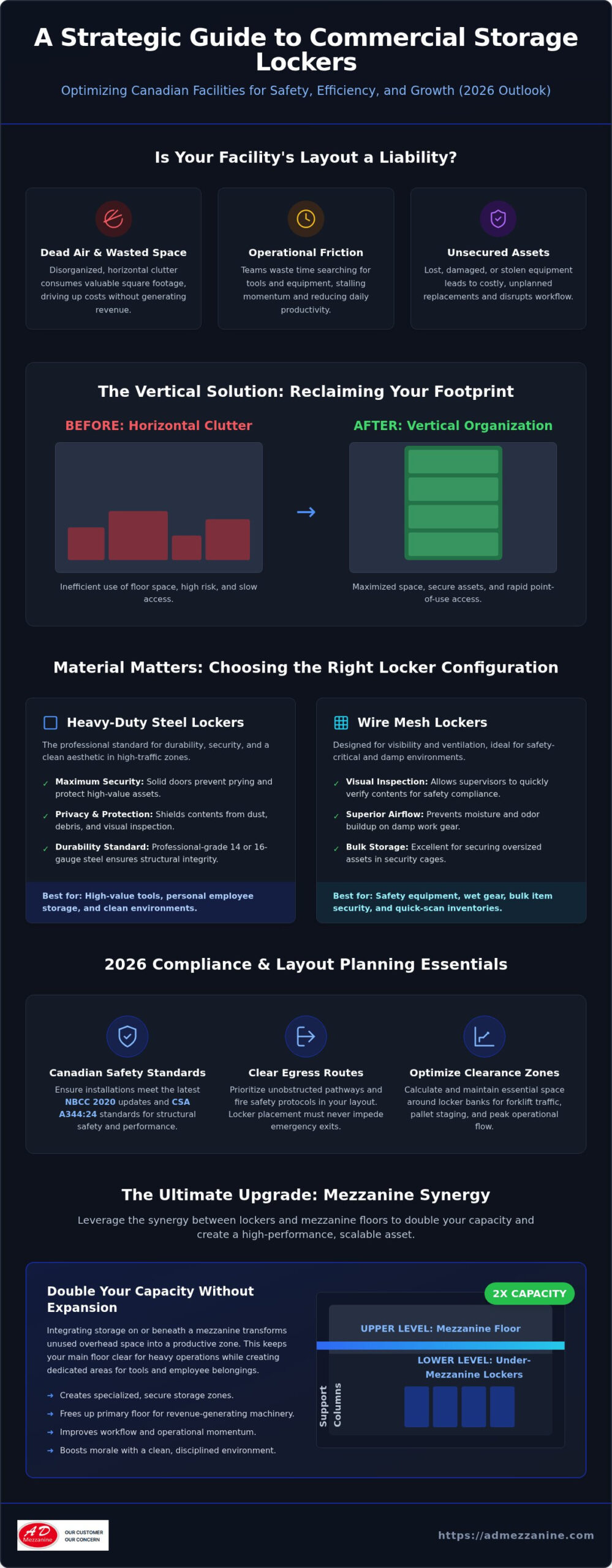
Every square foot of your facility carries a price tag. In the competitive landscape of commercial storage lockers Canada, the most successful operations don’t just see storage as a place to dump gear. They see it as a strategic tool to reclaim floor space. When your warehouse floor is littered with horizontal clutter, you aren’t just losing space; you’re losing money. Transitioning to vertical organization allows you to consolidate inventory that previously occupied valuable real estate into a compact, secure footprint. This shift is what separates a stagnant warehouse from a high-performing asset.
Operational momentum is the heartbeat of any Canadian industrial facility. When employees spend twenty minutes searching for a specific tool or piece of safety equipment, your momentum stalls. High-performance lockers eliminate this friction by creating a “point-of-use” culture. By placing gear exactly where it’s needed, you reduce transit time and keep your team focused on production. When evaluating Industrial Locker Types, it’s clear that the design and placement directly influence how quickly your team can pivot between tasks. Storage is no longer a passive utility; it’s a growth catalyst that drives daily efficiency.
The ROI of Organised Inventory
Canadian commercial real estate costs continue to climb, making wasted square footage an expensive luxury you can’t afford. Every pallet of “miscellaneous” items sitting on your floor represents a missed opportunity for revenue-generating machinery or inventory. Secure lockers don’t just organize; they protect. By reducing the frequency of lost or stolen equipment, you directly impact your bottom line and avoid the high cost of unplanned replacements. Space yield is the measurable ratio of revenue-generating floor area to the total square footage occupied by non-productive storage equipment.
Integrating Lockers into High-Performance Facilities
The most effective storage strategies involve mezzanine floor integration to double your usable area without expanding your building’s footprint. Placing lockers on or beneath a mezzanine creates specialized zones for high-value tools and employee belongings, keeping the main floor clear for heavy operations. There’s also a significant psychological component to this organization. A clean, disciplined workplace signals to your staff that their safety and productivity are priorities, which naturally boosts morale and output. It’s about creating a professional environment where every square inch is optimized for success.
Industrial Locker Types: Selecting the Right Configuration for Your Facility
A true commercial storage locker is a far cry from the flimsy units found in schools or gyms. In a high-traffic industrial environment, these units serve as reinforced, heavy-duty vaults designed to withstand daily abuse from heavy tools, safety gear, and constant use. When you invest in commercial storage lockers Canada, you’re choosing equipment that must maintain structural integrity under pressure. Selecting the wrong configuration doesn’t just waste money; it creates bottlenecks in your daily operations. You need to distinguish between standard lockers for personal effects and bulk storage security cages designed for oversized assets.
The hierarchy of materials starts with the choice between cold-rolled steel and wire mesh. Solid steel doors offer maximum privacy and a clean aesthetic, while wire mesh provides the advantage of visual inspection and superior airflow. This distinction is vital for safety; supervisors can quickly verify that no prohibited items are on-site without breaching locker privacy. While solid doors provide a barrier against dust and debris, ventilated mesh prevents the buildup of moisture on damp work gear, a common issue in varied Canadian climates. If you’re unsure which material fits your specific workflow, our specialists can help you audit your facility needs.
Material Science: Why Steel Grade Matters
In the world of industrial furniture, gauge thickness is the ultimate indicator of durability. Lower gauge numbers signify thicker, stronger steel. For frames and doors, 14 or 16-gauge steel is the professional standard, providing the rigidity needed to prevent prying or denting. Beyond the metal itself, the finish matters. Powder-coated finishes offer a durable, scratch-resistant surface, while galvanized options are essential for high-humidity areas to prevent rust. Choosing fully welded frames over knock-down, flat-pack units ensures your lockers won’t rattle or loosen over time, providing a much higher long-term ROI. Aligning your material choice with Canadian safety standards ensures your storage doesn’t just hold gear but actively protects your workforce.
Configuration Framework for Canadian Facilities
Matching locker volume to user needs is a balancing act of space and utility. Single-tier lockers are the gold standard for employees who need to store full-length winter coats and boots, while multi-tier configurations maximize density for smaller tool kits or personal electronics. For facilities that demand flexibility, mobile locker units on heavy-duty casters allow you to reconfigure your floor plan as your business grows. Don’t overlook specialty units; tool charging stations with integrated power strips and ventilated compartments are becoming essential for modern, tech-enabled Canadian trades. These aren’t just boxes; they’re high-performance hubs for your team’s essential equipment.
Safety Standards and Security Protocols for Canadian Commercial Storage
Safety in a Canadian industrial facility isn’t just a legal checkbox; it’s the bedrock of operational continuity. When you deploy commercial storage lockers Canada, you must align with the National Building Code of Canada (NBCC) 2020 and CSA A344:24 standards to ensure structural integrity and fire safety. One of the most overlooked aspects of locker installation is the maintenance of clear egress routes. Lockers should never encroach on designated fire exits or narrow the required hallway width, as this can lead to severe regulatory penalties and, more importantly, put your team at risk during an emergency.
Addressing the primary safety objection, tip hazards, requires a disciplined approach to installation. Any locker unit, especially those in high-traffic or seismic-prone regions, must be securely anchored to the floor or wall. By removing loose equipment from the floor and housing it in these secure units, you effectively eliminate trip hazards, which remain a leading cause of workplace injuries in Canadian warehouses. Organised storage is inherently safer storage.
OHS Compliance and Workplace Safety
Proper anchoring isn’t just a suggestion; it’s a requirement for seismic bracing in many Canadian provinces under the latest 2024 building code updates. These protocols prevent units from shifting or collapsing during unexpected structural stress, which is vital for protecting both inventory and personnel. Load capacity ratings represent the maximum weight a locker shelf or unit can safely support without compromising its structural stability or risking a dangerous collapse. By respecting these limits, you ensure your storage remains an asset rather than a liability.
Advanced Security for High-Value Assets
Security protocols have evolved far beyond the traditional padlock. While mechanical key systems remain a reliable baseline, many facilities are transitioning to electronic locker locks and RFID access to create comprehensive audit trails. This level of transparency allows managers to track who accessed which unit and when, providing a powerful deterrent against theft. Choosing professional storage locker solutions ensures that your high-value assets are protected by more than just a thin sheet of metal, mitigating internal shrinkage and protecting your bottom line.
Locker Layout Planning for Peak Operational Flow
Peak operational flow is the result of deliberate planning, not accidental placement. When you integrate commercial storage lockers Canada into your facility, you’re designing a traffic pattern that either accelerates or hinders your team. A common mistake is ignoring the “clearance zone” required for locker doors to swing fully open without blocking the aisle. In high-traffic corridors, this can lead to collisions or safety hazards. You must ensure that even with doors open, there is sufficient space for foot traffic and equipment movement. Strategically placing lockers near workstations reduces transit time, keeping your staff focused on their tasks rather than walking across the warehouse. Beyond safety, you must account for accessibility standards such as the AODA or similar provincial regulations. This means ensuring that locker handles and locks are at reachable heights and that aisles are wide enough for mobility devices to pass without obstruction.
The Audit: Assessing Your Square Footage
Stop thinking only about floor space. A smart audit looks at the total cubic volume of your facility. Are you using the dead space in corners or the perimeters of your mezzanine? By identifying these underutilised zones, you can place high-density storage where it won’t interfere with your main production line. Scalability is also key. Your locker system should be able to expand as your workforce grows, so plan for additional units now rather than trying to squeeze them in later. Measuring the footprint is just the start; you need to forecast how many users you’ll have in 2028 to ensure your investment remains viable as you scale.
Installation Best Practices
Before the first bolt is tightened, floor levelling is a mandatory step. Canadian industrial floors, especially in older buildings, are rarely perfectly flat. Shimming and levelling ensure that doors hang straight and locks engage smoothly every time. You also need to decide between wall-aligned rows, which save space, or island configurations, which allow access from both sides and can act as natural partitions between work zones. A final checklist should always include testing every door for alignment and ensuring that electronic locks, if installed, have reliable power or battery backups. When units are properly grouped and anchored, they become a permanent, reliable part of your facility’s infrastructure.
Scalable Storage Solutions: Why A D Mezzanine Inc. is Canada’s Choice for Industrial Lockers
A D Mezzanine Inc. serves as a growth catalyst for the Canadian industrial sector by transforming facility challenges into high-performing assets. We recognize that business owners don’t just need hardware; they need a strategic partner who understands the high stakes of Canadian real estate and operational flow. By offering a unified solution for mezzanines, partitions, and commercial storage lockers Canada, we simplify the procurement process and ensure every component of your facility works toward a single goal: maximum efficiency. Our national service scope means we maintain consistent standards of excellence across every province, delivering heavy-duty storage that meets the rigorous demands of the 2026 market.
The real advantage of working with a single partner lies in the synergy of our offerings. When you integrate storage lockers directly into a mezzanine project, you aren’t just adding furniture; you’re creating a multi-level ecosystem designed for speed and security. This disciplined approach to facility design ensures your square footage works twice as hard, providing secure housing for high-value equipment while keeping your primary production zones clear. We focus on performance-driven results that don’t just organize your space but actively increase its intrinsic operational value.
A Comprehensive Approach to Facility Expansion
Scaling an operation requires a methodical partner who sees the big picture. A D Mezzanine Inc. helps you look beyond the warehouse floor by integrating bike rack installations and lockers into cohesive end-of-trip facilities. This holistic view of workplace design supports the modern Canadian workforce, combining security with employee wellness. Whether you need custom-sized tool charging stations or heavy-duty cages for oversized inventory, our customization options ensure your unique commercial storage lockers Canada requirements are met with precision. Working with a disciplined partner means your project stays on track, from the initial audit to the final anchoring.
Ready to Optimise Your Facility?
The journey from a cluttered, high-risk environment to a streamlined, high-performing facility is a strategic evolution. By adopting a proactive approach to safety and efficiency, you protect your most valuable assets: your people and your equipment. Don’t let disorganized storage stall your business growth. It’s time to reclaim your floor space and build a foundation for long-term momentum. Our experts are ready to help you navigate the complexities of 2026 safety regulations and layout optimization.
Transform Your Facility Into a Strategic Asset
Your facility’s floor plan is either a bottleneck or a catalyst for growth. By shifting from horizontal clutter to a vertical, disciplined organization strategy, you reclaim valuable square footage and protect your bottom line. We’ve explored how the right commercial storage lockers Canada can double your capacity when integrated with mezzanine systems, all while ensuring full compliance with the latest 2026 safety regulations. Organizing your space isn’t just about tidiness; it’s about building a foundation for peak operational momentum.
AdMezzanine brings industrial-grade storage expertise and a national Canadian service scope to every project. We specialize in the seamless integration of mezzanines and lockers, ensuring your layout maximizes every cubic foot for your team’s success. It’s time to move beyond static storage and build a workspace that drives your business momentum. You have the strategic tools; now it’s time to put them into action.
The potential for your business growth is limited only by the efficiency of your environment. Let’s work together to build the high-performance facility your operations deserve.
Frequently Asked Questions
What are the most durable materials for commercial storage lockers in Canada?
High-grade cold-rolled steel and heavy-duty wire mesh are the most durable materials for commercial storage lockers Canada operations. For maximum longevity in industrial environments, look for units constructed from 14 or 16-gauge steel with powder-coated or galvanized finishes. These materials resist the denting, prying, and corrosion common in high-traffic warehouses. While solid steel provides privacy, wire mesh offers the structural rigidity needed for secure, long-term asset protection across varied Canadian climates.
Do commercial lockers require professional installation for safety compliance?
Professional installation is essential to guarantee your facility meets the National Building Code of Canada (NBCC) 2020 and provincial OHS standards. Certified installers ensure that units are correctly levelled and anchored to the floor or wall, which is a critical requirement for seismic safety in many regions. Skipping professional setup often leads to tip hazards or blocked egress routes, creating significant liability and safety risks for your workforce.
How much floor space should I allocate for locker door clearance?
You should allocate a clearance zone that accounts for the full swing of the locker door plus enough room for a person to pass. This usually requires a minimum of 36 inches of clear aisle space in front of the unit. Proper planning ensures your commercial storage lockers Canada installation doesn’t create bottlenecks or safety hazards. Maintaining these clear zones is also vital for meeting AODA accessibility standards and ensuring efficient operational flow.
Can I integrate storage lockers with an existing mezzanine floor?
Absolutely. Integrating lockers with a mezzanine is one of the most effective ways to double your usable square footage. You can install lockers on the mezzanine level to create secure employee zones or place them underneath to utilize otherwise dead space. This combination turns your facility into a high-performing asset by consolidating inventory vertically and keeping your primary production floor clear for heavy machinery and revenue-generating activities.
What is the difference between 16-gauge and 24-gauge steel lockers?
The primary difference lies in the thickness and structural integrity of the metal. In the steel gauge system, a lower number signifies a thicker material. 16-gauge steel is a robust, industrial-grade choice designed for heavy use and security. In contrast, 24-gauge steel is much thinner and more susceptible to denting or structural failure under pressure. For high-traffic commercial environments, investing in the thicker 16-gauge option provides a much higher long-term return.
Are there specific fire safety regulations for lockers in Canadian warehouses?
Canadian fire safety protocols, including those in the NBCC 2020, require that storage units never obstruct sprinkler heads or emergency exit paths. Industrial lockers must be positioned to maintain a minimum clearance from the ceiling to allow for effective fire suppression. Many facility managers choose wire mesh configurations because they allow water from overhead sprinklers to penetrate the unit, which can be a decisive factor during a formal fire safety inspection.
What are the benefits of ventilated mesh lockers over solid steel units?
Ventilated mesh lockers offer three distinct advantages: visual security, moisture control, and fire safety. The open design allows supervisors to verify contents without breaching privacy, which is essential for maintaining site discipline. Airflow is also critical for drying damp work gear or boots, preventing rust and odours. Mesh units don’t block sprinkler spray, making them a safer choice for high-density warehouses where fire suppression is a top priority for facility managers.
How do I choose between mechanical and electronic locker locks?
Your choice depends on your security needs and workforce turnover. Mechanical locks are dependable, cost-effective, and require no power source, making them ideal for standard tool storage. Electronic RFID or biometric locks are better for high-value assets because they provide digital audit trails. These smart systems allow you to track access and manage permissions remotely, which is a significant advantage for large teams or facilities with strict security protocols.