
Your facility’s floor space is your most valuable asset, yet it’s often the first thing to fail a sanitary audit when corrosion takes hold of standard structures. If you are struggling to scale within a regulated environment, stainless steel mezzanines offer the only permanent solution that combines industrial strength with medical-grade hygiene. You likely feel the pressure of maximizing every square centimetre while keeping up with the rigorous demands of Canadian health and safety regulations. It’s a common frustration to see standard platforms succumb to rust, turning a supposed solution into a maintenance nightmare.
We understand that facility expansion shouldn’t come with the heavy burden of regulatory stress or constant repairs. This guide promises to show you how to double your usable square footage and install a structure that lasts 25 years or more. You’ll discover how to pass every inspection with ease, shifting your focus from surviving audits to driving business momentum through smarter infrastructure.
We will break down the critical technical standards you need to know, including the Ra ≤ 0.8 μm finish requirements for food surfaces and the impact of the 2028 FSMA traceability rules. This is about more than just storage; it’s about building a foundation for long-term growth through superior corrosion resistance and industrial-grade durability.
Key Takeaways
- Identify the critical differences between 304 and 316 stainless steel grades to ensure your infrastructure matches your facility’s specific corrosion resistance needs.
- Discover how stainless steel mezzanines act as a growth catalyst by doubling your usable square footage while meeting strict Canadian sanitary and safety standards.
- Implement sanitary design principles that eliminate bacteria-trapping crevices, ensuring your elevated platforms remain easy to disinfect and audit-ready for decades.
- Execute a professional audit of your vertical space and floor slab capacity to determine precise load-bearing requirements for a safe, high-performance installation.
- Learn why custom-engineered solutions are essential for complex industrial environments where off-the-shelf platforms fail to meet unique footprint requirements.
What is a Stainless Steel Mezzanine and Why Choose It?
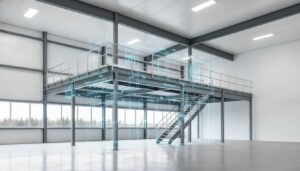
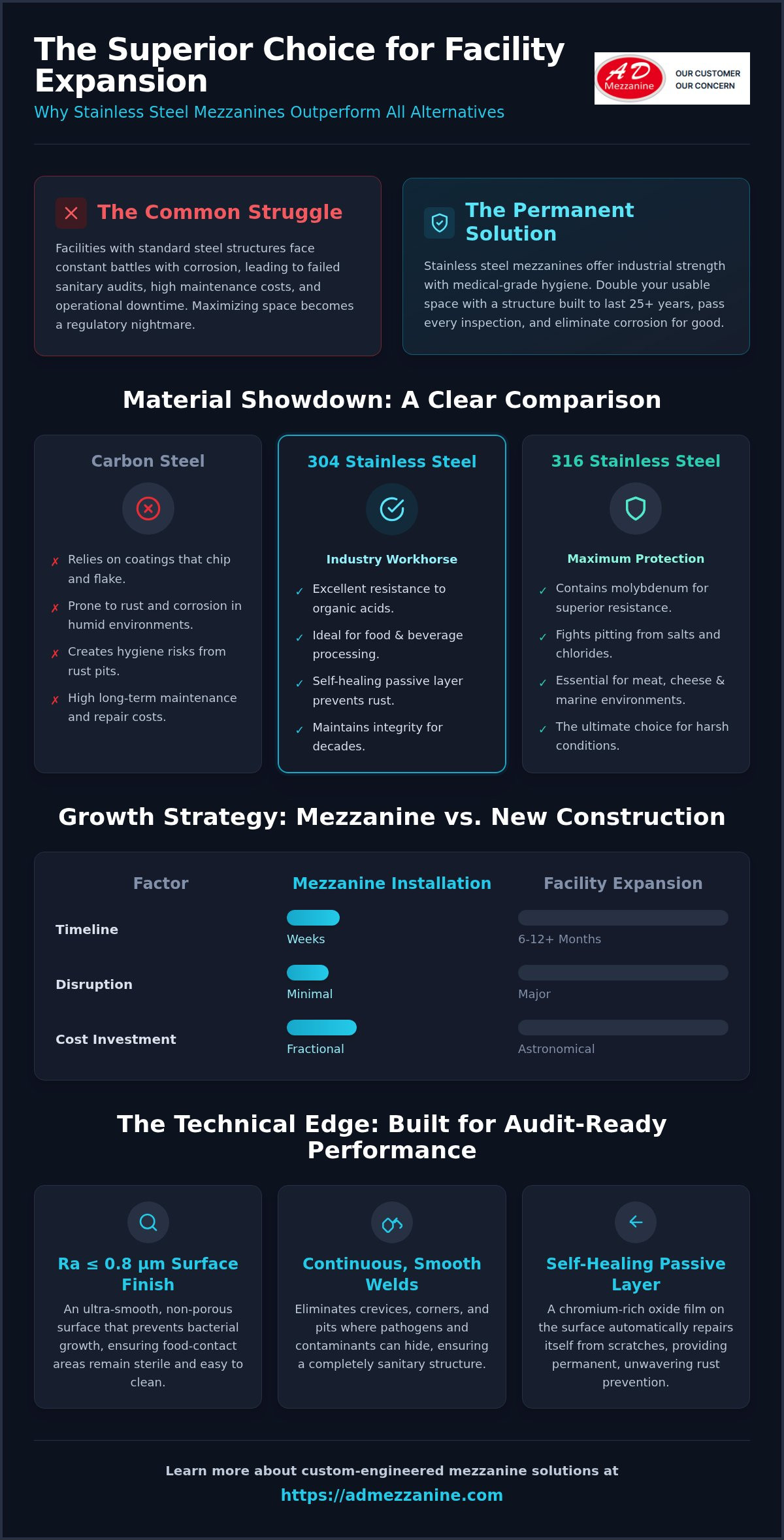
A mezzanine is a self-supporting elevated platform that creates an intermediate floor between the existing ground level and the ceiling. If you are researching what is a mezzanine, you’ll find it’s the most efficient way to expand your operation without altering the building’s exterior footprint. For Canadian facilities in the food, pharmaceutical, or chemical sectors, stainless steel mezzanines represent the gold standard for infrastructure. Unlike carbon steel, which relies on powder coatings or paint that eventually flakes and rusts, stainless steel provides a non-porous surface that stands up to the most aggressive industrial environments.
Choosing the right material isn’t just about aesthetics; it’s about long-term structural integrity. Carbon steel is prone to oxidation when exposed to the high humidity found in many industrial facilities. Once the protective coating is breached, the structure begins to degrade. Stainless steel eliminates this risk entirely. It offers a permanent solution that maintains its strength and sanitary profile for 25 years or more, even under constant exposure to moisture and organic acids. This makes it a high-impact investment for any business reaching capacity.
The ‘Stainless’ Advantage: Beyond Surface Aesthetics
The real power of stainless steel lies in its passive layer. This chromium-rich oxide film heals itself if the surface is scratched, preventing rust from ever taking hold. In a high-stakes facility, this means you don’t have to worry about paint chips falling into production lines or bacteria colonizing microscopic rust pits. It’s built to withstand daily high-pressure washdowns and caustic cleaning agents that would destroy lesser materials. This inherent durability ensures you pass every sanitary inspection without the need for costly repainting or structural repairs. It is the ultimate choice for maintaining a sterile environment.
Mezzanine vs. Facility Expansion: A Cost-Benefit Analysis
Are you considering a move to a larger facility? Before you commit to a new lease or a massive construction project, look up. Moving costs are often astronomical when you factor in downtime, new permits, and logistics. A custom mezzanine solution or elsewhere in Canada can double your usable floor area in a fraction of the time. While a building addition might take six months to a year to complete, a mezzanine can often be designed and installed in just weeks. It’s a strategic move that turns ‘dead’ vertical space into a high-performance asset, allowing your business to scale with minimal disruption.
The Technical Edge: Corrosion Resistance and Sanitary Design
Sanitary design isn’t a luxury; it’s a legal safeguard. In Canada, meeting CFIA requirements means your infrastructure must withstand rigorous cleaning without harbouring pathogens. While standard steel fails under this pressure, stainless steel mezzanines excel because they are built to be biologically inert. This technical edge comes down to how the material is handled and the specific alloy you select for your environment. It’s the difference between a structure that passes an audit and one that becomes a liability.
Choosing the Right Grade: 304 vs. 316 Stainless
Grade 304 is the workhorse of the food and beverage industry. It provides excellent resistance to the organic acids found in fruits and vegetables. However, when your process involves heavy salts or aggressive chemicals, Grade 316L is the necessary upgrade. It contains molybdenum, which specifically fights pitting in high-chloride environments. Grade 316 becomes a mandatory investment for any facility managing meat brining, cheese production, or marine-adjacent operations where corrosion is an accelerated threat.
Beyond the alloy, the surface finish is what prevents bacterial growth. For food contact surfaces, maintaining a roughness average (Ra) of ≤ 0.8 μm is the verified standard. This ultra-smooth finish ensures that microbes have no place to latch onto during production. When combined with continuous, ground-smooth welds, your mezzanine becomes a seamless part of your sterile environment. This level of detail is why custom engineering outperforms off-the-shelf units every time.
Sanitary Features and Washdown Capabilities
Your choice of decking impacts both drainage and airflow. Open-grid stainless steel allows for maximum ventilation and prevents liquid pooling, which is vital in high-moisture zones. Solid decking with sloped drainage is better for cleanroom environments where you must prevent debris from falling to the floor below. These features ensure your daily sanitation cycle is fast and effective, reducing downtime and labour costs. Non-porous materials don’t just look cleaner; they are fundamentally easier to disinfect.
Safety is just as critical as hygiene. Your structure must adhere to OSHA safety standards regarding guardrail height and load-bearing capacity. In Canada, this often means ensuring your mezzanine integrates seamlessly with existing safety protocols while preparing for the July 20, 2028, compliance dates for stricter traceability under FSMA Rule 204. By choosing a material that never degrades, you ensure your safety features remain as robust on year 20 as they were on day one. If you’re unsure which configuration fits your workflow, speak with a design expert to audit your facility’s specific needs.
Strategic Applications: Where Stainless Steel Outperforms
Material selection is a high-stakes decision that directly impacts your facility’s operational lifespan. In environments where corrosive vapours or frequent chemical spills are the norm, stainless steel mezzanines aren’t just an upgrade; they are a strategic necessity. Industrial laboratories and chemical plants dealing with caustic substances require infrastructure that won’t degrade under chemical stress. While standard steel might seem cost-effective initially, the recurring cost of rust remediation in these aggressive settings quickly erodes any perceived savings.
Food Grade Solutions: From Bakery to Meat Processing
High-pressure steam cleaning is the standard for Canadian bakeries and meat processing plants. Standard painted steel simply can’t handle the thermal shock or the constant moisture. It eventually flakes, creating a significant contamination risk. Stainless steel provides a zero-contaminant surface that ensures your industrial mezzanine solutions remain safe for both direct and indirect food contact. It stands up to organic acids and heavy washdown cycles without losing its structural integrity or sanitary profile.
Pharmaceutical and Cleanroom Integration
Cleanrooms have zero tolerance for particulates or outgassing. Polished stainless steel finishes offer a smooth, non-shedding surface that doesn’t trap dust or harbour microbes. These structures integrate perfectly with existing HVAC and filtration systems, maintaining the strict air quality standards required for biotech operations. Because the material is naturally resistant to the aggressive disinfectants used in pharmaceutical settings, it remains pristine and audit-ready for decades. It reflects a commitment to sterility that standard materials cannot match.
Cold storage facilities and industrial freezers present another unique challenge: extreme temperature fluctuations. Carbon steel can become brittle in deep-freeze conditions, leading to potential structural failures. Stainless steel maintains its ductility and strength even at sub-zero temperatures. This makes it the ideal choice for Canadian facilities that need to maximize vertical storage in refrigerated environments without compromising safety. Whether you are managing a high-output food plant or a sensitive laboratory, choosing a material that survives your specific environmental stressors is the key to a high-ROI installation.
Planning Your Installation: Design, Loading, and Safety
Successful installation starts with a rigorous assessment of your facility’s current footprint. You aren’t just adding a floor; you’re integrating a complex structural system into an active production environment. Precision at the planning stage prevents costly retrofits and ensures your stainless steel mezzanines deliver maximum ROI from day one. It’s about turning a blueprint into a functional profit centre that enhances your workflow rather than obstructing it.
Follow these five essential steps to ensure a seamless integration:
- Step 1: Conduct a thorough vertical space and floor slab audit to check for overhead obstructions and concrete thickness.
- Step 2: Determine precise load-bearing requirements in pounds per square foot (PSF) based on your heaviest equipment.
- Step 3: Map out egress points, stairways, and material handling flow to maintain peak operational efficiency.
- Step 4: Select decking and railing materials that match your specific sanitation and grip requirements.
- Step 5: Verify compliance with local Canadian building codes and OSHA safety standards to guarantee a legal and safe workspace.
Calculating Load Capacity and Structural Requirements
Understanding the distinction between dead loads and live loads is fundamental to structural safety. Dead loads refer to the weight of the mezzanine itself, while live loads include your staff, moving equipment, and stored inventory. Your floor slab thickness dictates where columns can be placed; if your slab is less than 6 inches thick, you may need specialized footings to distribute the weight. We recommend over-engineering your structure to handle future equipment upgrades, ensuring your investment remains viable as your business scales toward 2030 and beyond.
Integrated Safety Systems: Guard Rails and Gates
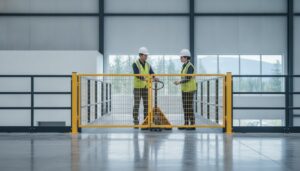
Safety and hygiene must work in tandem. In washdown environments, safety guard rail systems made of stainless steel are non-negotiable because they won’t rust or harbour bacteria. OSHA standards require a top rail height of 42 inches, plus or minus 3 inches, and the structure must withstand at least 200 pounds of force. You’ll also need to choose between swing gates for manual loading or sliding gates for pallet access. These choices define how safely and quickly your team can move materials between levels without risking falls or injuries.
Custom Mezzanine Solutions: Maximizing Facility Potential
Off-the-shelf mezzanines often fall short when faced with the realities of a high-performance Canadian facility. A generic kit doesn’t account for your specific drainage slopes, existing HVAC ducting, or the unique load-bearing constraints of your floor slab. When you choose custom stainless steel mezzanines, you’re investing in a structure that wraps around your existing operations rather than forcing you to work around it. This tailored approach is what distinguishes a simple storage platform from a strategic growth catalyst.
At A D Mezzanine Inc., we believe your facility should work as a unified system. Our engineering process focuses on the “why” of your expansion, ensuring that the final structure supports your long-term business momentum. By opting for a custom build, you eliminate the safety gaps and sanitary risks associated with ill-fitting, mass-produced units. It’s about creating a foundation that’s as disciplined and organized as the team working on it.
Creating a Holistic Facility Ecosystem
Efficiency doesn’t stop at the mezzanine floor. To truly maximize your square footage, you need to think about how different components interact. Integrating stainless steel partitions allows you to create dedicated washdown zones or temperature-controlled areas without the permanence of masonry walls. This flexibility is vital for facilities that need to adapt to changing Canadian regulations or evolving production lines.
Secure equipment management is equally important. By installing industrial storage lockers directly on or beneath your mezzanine, you reduce unnecessary foot traffic and keep essential tools within reach. This creates a self-contained work ecosystem that boosts productivity while maintaining the highest standards of organization and safety. Every square centimetre is utilized to its full potential.
The Path to Implementation: Getting Started
Moving from a crowded floor to a high-capacity facility starts with a professional consultation. You’ll work with an expert to finalize a layout that optimizes your vertical space while ensuring full structural certification. Professional installation is a guarantee that your investment meets all local building codes and load-bearing standards. It provides the emotional sense of security that comes from knowing your team is working on a rock-solid foundation.
The long-term ROI of this approach is clear. While the initial investment in stainless steel is higher than carbon steel, the total cost of ownership is significantly lower. You’ll never spend a cent on repainting, rust remediation, or structural repairs caused by corrosion. It’s a maintenance-free solution that allows you to focus on your core business goals rather than facility upkeep. Reach out to a specialist today to start the transition from a congested workspace to a streamlined, high-output operation.
Secure Your Facility’s Future with High-Performance Infrastructure
Investing in stainless steel mezzanines is a strategic move that eliminates the endless cycle of rust remediation and audit anxiety. By doubling your vertical capacity with a corrosion-resistant structure, you’re building a foundation that remains pristine for over 25 years. We provide nationwide engineering support across Canada and custom sanitary design expertise to ensure your facility meets every CFIA and OSHA standard. From integrated guard rails to secure partitions and lockers, we deliver complete facility safety systems tailored to your unique operational footprint.
This is about more than just adding floor space; it’s about creating a disciplined, high-output environment that scales with your ambition. You’ve seen how the right material grade and a professional planning audit can transform your ROI. Now is the time to turn that technical edge into a tangible business advantage. Our team is ready to help you navigate the complexities of load-bearing certifications and sanitary compliance.
Don’t let floor space constraints or shifting regulatory hurdles stall your business momentum. Take control of your facility’s potential today and start your expansion with a partner who is deeply invested in your long-term success.
Frequently Asked Questions
Are stainless steel mezzanines more expensive than carbon steel?
Stainless steel mezzanines require a larger initial investment than carbon steel, but they offer a significantly lower total cost of ownership. You won’t face recurring expenses for repainting or rust remediation, which are common with painted steel in humid environments. Over a 25-year lifespan, the savings on maintenance and the prevention of sanitary audit failures make stainless steel the more cost-effective choice for regulated Canadian facilities.
What is the typical lead time for a custom stainless steel mezzanine?
Custom lead times generally range from 8 to 12 weeks from the final design approval to delivery. This timeline accounts for precise engineering, material procurement, and high-standard fabrication. Factors like current supply chain conditions in North America and the complexity of your facility’s footprint can influence the schedule. We prioritize an organized process to ensure your expansion moves forward without unnecessary delays or production bottlenecks.
Do I need a building permit to install a mezzanine in my facility?
Yes, you almost always need a building permit to install a mezzanine in a Canadian facility. Because these are structural additions, they must comply with local building codes and safety regulations. We recommend working with an engineer who understands provincial requirements to ensure your design is certified. This step is crucial for maintaining your insurance coverage and passing future safety inspections with total confidence.
Can a stainless steel mezzanine be moved if we relocate our business?
These structures are designed as bolt-together systems, making them fully demountable and relocatable. If your business outgrows its current space or you decide to move your operations, the mezzanine can be disassembled and reinstalled at your new site. This flexibility protects your capital investment and allows your infrastructure to move with you as your business scales and evolves across the country.
What is the weight capacity of a standard industrial mezzanine?
A standard industrial mezzanine is typically engineered to support a live load of 125 to 250 pounds per square foot (PSF). However, we can customize the structural design to handle much heavier loads if you plan to install heavy machinery or high-density racking. Determining your precise weight requirements during the audit phase ensures your platform remains safe and stable under the most demanding daily operational stresses.
How do I choose between 304 and 316 stainless steel for my platform?
Choose 304 stainless steel for general food and beverage applications where standard moisture is the primary concern. If your facility handles high-salinity products, like meat brining or cheese production, or uses aggressive chemical cleaners, Grade 316 is the necessary choice. The addition of molybdenum in Grade 316 provides the superior pitting resistance required to survive those harsher, high-chloride environments without degrading over time.
Is a stainless steel mezzanine compatible with existing washdown systems?
Stainless steel mezzanines are specifically engineered for full compatibility with high-pressure washdown and steam cleaning systems. The non-porous nature of the material ensures that water and cleaning agents drain away effectively without causing structural damage. By choosing open-grid decking or sloped solid surfaces, you can maintain a sterile environment and reduce the time your team spends on daily sanitation cycles.
How long does the installation process typically take on-site?
On-site installation typically takes between three and seven days for a standard-sized structure. Because much of the fabrication happens off-site, the assembly process is fast and creates minimal disruption to your existing workflow. Larger or more complex systems integrated with safety guard rails and partitions may require additional time. Our goal is always to get your new floor space operational as quickly as possible.